
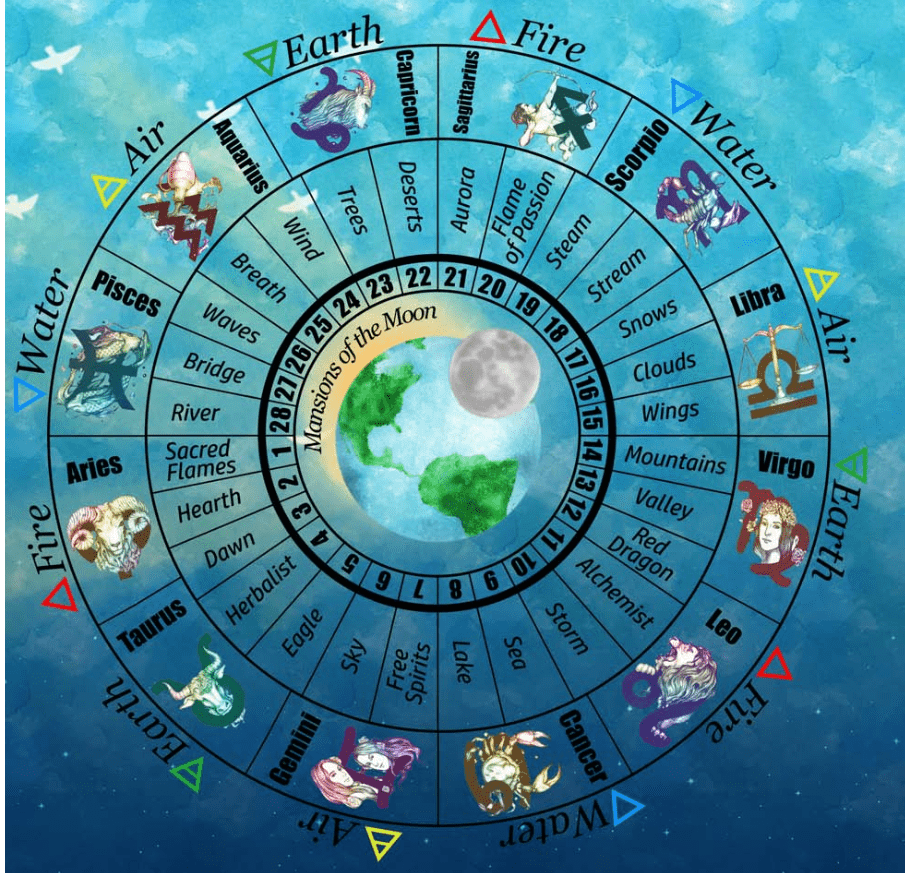
The Mansions of the Moon, also known as “Lunar Mansions,” are an ancient astrological concept that divides the Moon’s monthly path through the zodiac into 28 distinct segments. This system has roots in various cultures, including Babylonian, Indian, and Islamic traditions, reflecting the Moon’s changing positions and its purported influence on earthly events. Each mansion is associated with specific attributes, symbolic meanings, and influences that correspond to lunar phases and astronomical alignments. The ancient meanings have almost become obsolete as many were focused on the needs of ancient monarchs and the need for “a day for taking new slaves” is not too useful, so they have faded into obscurity. But there is a new life for them now. A modern updated listing of the Mansions based on their underlying Zodiac signs and elemental energies is bringing new life and use to this ancient study.
Origins and Cultural Significance
The concept of dividing the lunar orbit into sections likely originated in ancient Mesopotamia, where early astronomers observed the Moon’s journey against the backdrop of stars. As early as 2000 BCE, Sumerians identified constellations that marked these divisions. The Babylonians refined this system further, correlating lunar phases with agricultural cycles and social events.
In India, the Nakshatras—27 or 28 lunar mansions—are integral to Vedic astrology. They are crucial in determining auspicious dates for religious rituals, marriages, and other significant life events. Each Nakshatra holds unique mythological significance and is linked to specific deities.
In Islamic astronomy, the Mansions of the Moon were adopted into Arabic culture as “Manazil al-Qamar,” serving both astrological and meteorological purposes. Medieval Islamic scholars expanded on Greek and Roman astrological texts, incorporating lunar mansions into a broader framework of celestial influences.
The Picatrix: An Ancient Text
The Picatrix is an influential grimoire of astrological magic that provides insight into how the Mansions of the Moon were perceived and utilized during the medieval period. Originally written in Arabic as “Ghayat al-Hakim” around the 10th or 11th century, it was later translated into Latin in the 12th century. The text synthesizes various traditions of astrology, philosophy, and magic from earlier Greek, Persian, and Indian sources.

The Picatrix offers a detailed account of each lunar mansion’s characteristics and their astrological implications. It describes how each mansion holds power over particular aspects of life, such as love, health, travel, or warfare. The text outlines how these celestial divisions can be harnessed through rituals and talismans to influence desired outcomes. However, as noted, the 5,000-year-old interpretations it offers have little application to today’s modern world.
The Picatrix’s treatment of lunar mansions influenced Western esoteric traditions significantly during the Renaissance when interest in astrology surged anew across Europe. Scholars like Marsilio Ficino drew upon its teachings while developing their own frameworks for understanding cosmic influences on human affairs.
Alchemy too found inspiration here—alchemists saw parallels between transforming base materials into gold (the philosopher’s stone) and harnessing astral energies via talismanic magic described within this ancient tome. It was as a student at the Alchemy Guild my studies allowed for an updating of the Mansions. This study was accepted as my thesis and resulted in my certification as an Alchemist of the Alchemist Guild. The study updates the Mansion to modern English names and their energies to those more applicable to modern life.
For more details on the updated Mansions and how to use them, join us in the Discussion Forums.
I am well aware that modern-day Moon Astrologers may view these evolving concepts differently, but respecting historical contexts while keeping Astrology relevant enriches the field. An appreciation for diverse contributions shaping humanity’s enduring fascination with stars above—and the mysteries they hold within them—is a joyful exercise.
Hank Mason
Alchemist
You must be logged in to post a comment.