
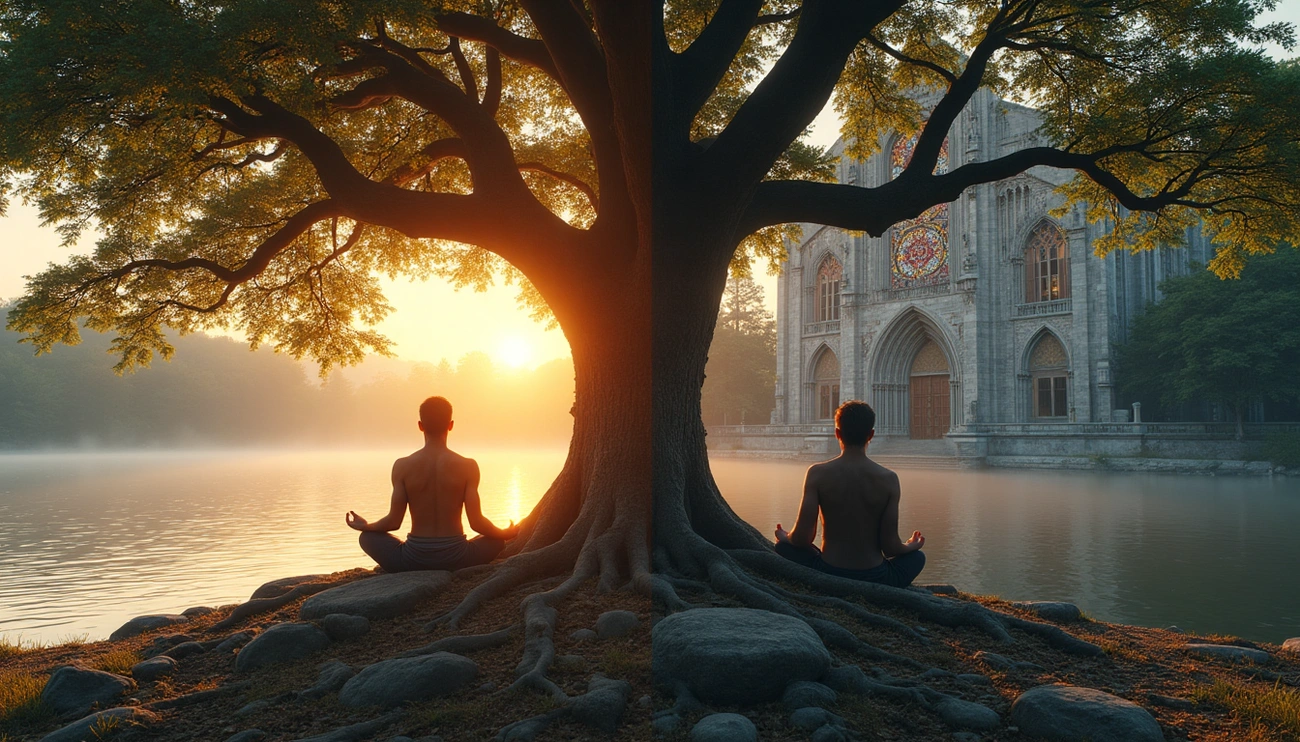
The modern world has witnessed a fundamental change in how people view spirituality and religion. Religious dominance has steadily declined in Western societies since the European Enlightenment of the 17th century. Many people feel a deep spiritual emptiness that persists even with financial security and stable careers.
Religious institutions provide structured beliefs and practices. Spirituality offers a more personal path to meaning and connection. More people now describe themselves as “spiritual but not religious.” They seek answers that match their personal experiences instead of following traditional religious frameworks. This distinction between spirituality and religion goes beyond mere words. The difference shows how people approach life’s big questions. Modern spirituality can work alongside scientific understanding, which traditional religion often struggles with. This piece explores seven surprising contrasts between religious and spiritual approaches. These insights help explain why many people choose spiritual paths in our increasingly secular world.
Definition of Spirituality and Religion
The difference between spirituality and religion starts with their basic definitions. These related concepts show two unique ways people connect with the sacred and find meaning in life.
Spirituality: Inner connection and personal growth
Spirituality is a deeply personal trip that centers on inner exploration and connection to something bigger than ourselves. Joseph et al. describe spirituality as “a more general, unstructured, personalized, and naturally occurring phenomenon, where a person seeks closeness and/or connectedness between him/herself and a higher power or purpose” [1].
At its heart, spirituality is about personal growth and finding inner truths that exceed everyday life experiences. It creates a multi-layered framework based on finding inner peace, harmony, and connections with others [1].
Spirituality stands out because it’s flexible and adaptable. Unlike religion’s structured framework, people can create their own path to meaning. This growth happens both inside through self-improvement and outside through connections to something greater—whether that’s the divine, the universe, or a shared consciousness [1].
Spirituality has “a sense of connection to something bigger than ourselves, and it typically involves a search for meaning in life” [2]. People show this connection through meditation, mindfulness, contemplation, and self-reflection. Personal experience matters more than following external authority.
Hart explains spirituality as the way people experience faith in daily life and “refers to the final conditions of individual existence” [1]. This personal aspect lets spirituality grow with each person and adapt to new insights.
Religion: Organized beliefs and external rituals
Religion, on the other hand, has organized systems of beliefs and practices shared by communities. It comes with specific doctrines, scriptures, and moral codes that religious authorities have created [3]. The word “religion” comes from Latin words that mean “respect for what is sacred” and “to bind,” which suggests both reverence and duty [4].
Religious structures help people understand the divine and moral duties through sacred texts that are the life-blood of believers. Religion brings people together for worship and follows established doctrines [5].
Durkheim saw religion as “a unified system of beliefs and practices relative to sacred things… which unite into one single moral community, called a church, all those who adhere to them” [4]. This community aspect creates a social institution where clergy guide and congregations offer belonging and support.
Religion has four main parts: beliefs (ideas and values), mythology (supernatural and sacred stories), practices (rituals and rites of passage), and social organization (community) [4]. These elements create structure, authority, and emotional support for followers.
Religious practices are fixed, which gives stability and comfort. Followers know what they need to do and how to connect with the divine through established rituals [5]. Religion often acts as a social bond that holds society together through shared values and practices [4].
The main difference between spirituality and religion lies in how they approach higher powers. Religion uses specific beliefs and “holy men” as go-betweens for people and Spirit. Spirituality lets individuals define and connect to Spirit in their own way [6].
1. Source of Authority: Inner Guidance vs External Dogma
“Religion is belief in someone else’s experience. Spirituality is having your own experience.” — Deepak Chopra, Physician, author, and alternative medicine advocate
A belief system’s foundation depends on its source of authority—the place where truth and guidance originate. This key difference between spirituality and religion affects how people make decisions, find answers, and direct their lives through challenges.
Spirituality: Personal experience and intuition
Spiritual practice centers on deep trust in our inner guidance system. Spiritual seekers know that “all the wisdom of the Universe exists within” and that “there is no one and no thing that has greater authority or expert opinion about what is in alignment with our unique experience than our inner-knowing” [7]. People now tap into internal wisdom rather than seeking external validation.
Your intuition works as a vital compass on the spiritual path. Many spiritual teachers stress that connecting to our intuition is “paramount” when personal and global transformation happens [7]. This intuitive guidance works faster than conscious thought and serves as both protector and advisor.
Gavin De Becker, author of The Gift of Fear, explains that intuition “is always in response to something” and “always has your best interest at heart” [8]. This shows intuition not as something supernatural but as a powerful internal resource that alerts us to dangers and opportunities.
Your intuition can even warn you early about physical and emotional health issues. Dr. Judith Orloff points out in Intuitive Healing that “illness can be detected and reversed long before physical signs appear” through intuitive signals [8]. Spiritual practitioners see these bodily messages as essential self-care and self-respect.
Beyond protection, intuition guides spiritual growth like a GPS [7]. People who connect with their inner knowing more often find “opportunities to use intuition” in everyday life [7]. Regular practice strengthens these intuitive abilities naturally.
Religion: Scriptures, clergy, and tradition
Religious systems place authority in external sources—mainly scriptures, clergy, and time-honored traditions. Religion acts as “an intermediary, a structured system of beliefs and doctrines, often with dedicated clergy acting as ‘representatives’ of the divine” [9]. This creates a bridge between people and the divine.
Religious authority shows up in several ways. Sacred texts provide the base for religious understanding. Protestants consider the Bible “the only rule of faith” with “all of the material one needs for theology” [10]. This view makes anything outside scripture “non-authoritative, unnecessary, or wrong” [10].
Catholics see things differently. They believe “the true ‘rule of faith’…is Scripture plus apostolic tradition, as manifested in the living teaching authority of the Catholic Church” [10]. This teaching authority, or magisterium, interprets scripture and keeps doctrine consistent.
Religious institutions work through clergy who guide people and interpret sacred texts. Religious doctrine “often fosters a passive state, with scripture as the sole accepted source of knowledge,” while spirituality “awakens one’s inner divinity, revealing countless ways to access wisdom” [9].
Modern technology has changed religious authority but kept its external nature. The Vatican’s official website offers centralized, authoritative teaching. These sites get their legitimacy from “authority outside the online environment” [11]. Traditional religious structures adapt to modern formats while keeping their core approach to authority.
Religious practice focuses on “not my will but thy will be done,” while spiritual seekers prefer to “follow your own bliss” [12]. This shows a clear difference in where authority lies and how it works in people’s lives.
2. Relationship with the Divine: Direct vs Mediated
The biggest difference between spirituality and religion lies in how people connect with the divine. This shapes their entire spiritual or religious experience and affects their beliefs, practices, and relationships with higher powers.
Spirituality: Direct connection with the divine
Spiritual paths let people experience the divine directly. Each person has a direct line to higher consciousness without needing external validation or interpretation. A practitioner explains this connection as “a deeply personal and individual journey towards understanding and connecting with the divine.” The focus stays on “inner exploration, self-discovery, and forging a personal relationship with a higher power” rather than following organized doctrines [13].
This approach shows itself through various spiritual practices that create firsthand experience. People use meditation, mindfulness, nature walks, and artistic expression as personal gateways to surpass normal consciousness [13]. Many spiritual seekers talk about transformative experiences they describe as “a sense of peace, enlightenment, or unity with the universe” [13].
The heart of this relationship recognizes that “you are a spiritual being having a human experience” and “your connection is non-negotiable because you are an aspect of the divine made form” [14]. People deepen this connection through regular spiritual practices like “prayer, meditation, and walking in nature” [1]. Many people share profound experiences where they “felt a divine light flowing through” their bodies that brought clarity and healing [1].
Religion: Intermediaries like priests or prophets
Religious traditions use intermediary figures to help connect followers with the divine. These intermediaries have taken many forms throughout history—prophets, priests, and clergy—each with unique roles in their religious contexts.
Prophets say they have “direct communication with the supernatural realm” and can “communicate divine messages to others” [2]. Muhammad in Islam and Moses in Judaism and Christianity stand out as examples who received direct revelations from God [2]. Religious prophets get their authority “from direct connection to the divine and ability to convince others” through charisma [2].
Priests work differently than prophets. They get their authority “from scripture and occupational position in formally organized religious institutions” [2]. They act as “the intermediaries between God (or the gods) and humans” [2]. Christian priests complete “formal higher education,” while Hindu priests (pujari) must “learn Sanskrit and spend years becoming proficient in ceremonies” [2].
The Catholic Church sees these figures as “mediators between God and man, foreshadowing the true Mediator, Christ” [15]. This mediated relationship creates a structured path to divine connection through established channels. Here, “intermediaries often serve as agents of divine will, bridging the gap between God and humanity” [16].
Religious theologian Carl Jung noted that “one of the main functions of organized religion is to protect people against a direct experience of God” [17]. His observation shows how religious structures can both help and control divine encounters.
The choice between spirituality and religion comes down to whether you want direct experience or guided access to the divine. Each path offers unique advantages for people on their spiritual journey.
3. Practice and Expression: Fluid vs Structured
“Spirituality is not about religion or ideology. It’s about experiencing the depths of your innermost being.” — Sadhguru, Yogi, mystic, and founder of Isha Foundation
Our beliefs show a clear difference between spirituality and religion. The way we practice our faith shapes how we experience the sacred, whether through personal exploration or community ceremonies.
Spirituality: Meditation, mindfulness, and self-reflection
Spiritual practice takes a fluid, personal approach that puts inner exploration first. People who seek spirituality create their own practices that appeal to their understanding of the divine. These practices can be meditation, mindfulness, nature walks, journaling, or artistic expression—each one opens a personal gateway to surpass ordinary experience.
Reflective practices are the life-blood of spiritual expression. They help us “become aware of our own state of being” and bring us “back to ourselves, allowing us to come closer to our own body, emotions, thoughts, and spirit” [4]. These contemplative activities let us find “an openness to seeing things as they are, not how we think they should be” [4].
Mindfulness meditation stands out as a perfect example of the spiritual approach. Many people link reflective practice with sitting meditation, but spiritual practices include many techniques:
-
Walking meditation and moving practices like yoga or Tai Chi
-
Journaling and artistic expression with intention
-
Nature immersion and mindful observation
-
Prayer and contemplation as personal dialog
These practices help us “pay attention to what is happening right now” and “become aware of how we are truly feeling in this moment” [4]. They help us see “the great gift of simply being in the present moment – alive and aware” [4].
Spiritual practices stand out because you can adapt them. Modern spirituality has become more personal, and practitioners mix “different practices—from meditation to yoga to energy healing—to create something that feels unique and authentic to them” [18]. This shows “a growing desire for spiritual freedom and self-expression in their spiritual lives” [18].
Religion: Rituals, ceremonies, and fixed practices
Religious expression relies on structured traditions that follow set patterns. A ritual is “a sequence of activities involving gestures, words, actions, or revered objects” that are “prescribed by the traditions of a community” [19]. Every human society has rituals, from worship ceremonies to rites of passage.
Religious rituals have unique features that set them apart from spiritual practices. They show formalism by using “a limited and rigidly organized set of expressions” [19]. They value traditionalism and “continued to repeat historical precedent, religious rite, mores, or ceremony accurately” [19]. Religious rituals also maintain invariance with “careful choreography” and “striving for timeless repetition” [19].
Liturgical traditions are “established forms and practices used in public worship” that follow “a prescribed order throughout the liturgical year” [6]. These traditions have several parts:
“Prayer: Structured prayers are integral to many liturgies, offering a means of communication with the divine. Readings: Excerpts from sacred texts are often recited or read aloud, providing theological insights and moral guidance. Hymns: Music plays a crucial role, with hymns sung to uplift the spiritual atmosphere. Ritual Acts: Actions such as lighting candles, kneeling, and making the sign of the cross are all part of the liturgical expression” [6].
These practices might seem strict, but they serve important purposes. Rituals “buffer against uncertainty and anxiety” [20], build social bonds, and help people “come to terms with the major events of life” [21]. Research shows that “ritualistic behavior can improve social bonding when we practice it collectively” [20].
The core difference between spiritual and religious practices reflects their basic approach—spirituality values flexible, personal exploration while religion gives structure through time-tested traditions. All the same, both ways want to connect people with something greater than themselves.
4. Moral Compass: Self-Awareness vs Rule-Following
The way we tell right from wrong shows a key difference between spirituality and religion. Our moral decision-making reveals deep contrasts in how spiritual and religious paths tackle ethical questions.
Spirituality: Inner transformation and self-honesty
Spiritual moral frameworks use self-awareness and personal integrity as foundations for ethical behavior. Research shows that people compare themselves to various standards and ideals, including moral ones. This comparison acts as the “primary function of self-awareness” and makes self-regulation possible [22].
Radical self-honesty sits at the core of spiritual ethics. You must be willing to look at your true motivations and behaviors without deceiving yourself. Spiritual teachers say this practice involves “naming what is here, staying with it, and saying it out loud to others.” This helps wash away “the last bits of shame that cling to it” [23].
Spiritual integrity combines “the state of being undivided together with the quality of brutal self-honesty” [24]. This path needs deep self-awareness and unwavering authenticity. You must recognize when you’re not honest with yourself—like when you control your actions to manipulate others’ reactions or harbor hidden agendas [24].
The spiritual moral compass works through:
-
Self-reflection that helps us “become aware of our own state of being” [3]
-
Taking responsibility for our actions instead of blaming circumstances
-
Acknowledging our true feelings, even uncomfortable ones
-
Developing autonomy through thoughtful deliberation about choices
Autonomy alone isn’t enough to drive moral behavior. Psychologists point out that “an autonomous person unresponsive to inner and outer expectations could be a rebel, delinquent sociopath interested only in personal gain” [5]. Spiritual morality needs both autonomy and empathy—reflection paired with genuine care for others.
Religion: Obedience to commandments and moral codes
Religious moral frameworks focus on external standards and following established codes. History shows that morality and religion connect “primarily by the category of God’s command” [25]. Sacred texts like the Hebrew Bible showcase this command-based morality, where God creates “a kind of covenant by which humans will be blessed if they obey the commands God gives them” [25].
The Ten Commandments show this approach clearly. They split moral obligations between those toward God and those toward other humans [25]. Religious ethical systems value rule-following, with laws serving multiple purposes. Theologians see a “threefold use of the law” [7]:
The political use creates “a solid basis for deciding what makes good or bad law” [7]. The pedagogical use makes the law a teacher that “convicts people of their sin” [7]. The third use guides us by showing “what is right, helping us to be discerning in the tangled jungle of moral decisions” [7].
Religious moral frameworks give clear standards in uncertain times. The Judeo-Christian commandments ban behaviors that “undermine group harmony: murder, theft, lying, adultery” [22]. This structure offers security through clear boundaries.
Religious traditions see deeper aspects of morality beyond simple rule-following. Jesus taught that the spirit of the law lives within its letter, with “serious consequences for violating the ‘spirit’ of the law” [7]. Many religious teachers stress that “the law defines the way of love and should never contradict it in theory or in practice” [7].
Both paths—spiritual self-awareness and religious rule-following—give us meaningful ways to live ethically. Each brings unique strengths to help navigate life’s moral complexities.
5. Inclusivity: Open Exploration vs Fixed Beliefs
The way spirituality and religion handle different views marks a significant difference between them. Each path has its own way of looking at truth and how people experience it.
Spirituality: Embraces multiple paths and views
Spirituality welcomes many different viewpoints and practices. The blending of spiritual paths, known as syncretism, goes back many years. Spiritual knowledge moved freely between traditions. Hopi, Mayan, and Cherokee elders shared their wisdom before colonial times [8].
Following multiple spiritual paths at once helps us grow by:
-
Knowing how to hold different worldviews at once
-
Asking better questions about what we believe
-
Testing fixed “truths” against universal wisdom found in many forms [8]
This open approach works like getting several doctors’ opinions. One doctor might be wrong, but when several agree, you can trust the diagnosis more [8]. Finding similar spiritual themes in far-apart traditions makes them more credible.
We focused on personal exploration without demanding loyalty to just one path. A practitioner put it well: “We can be both this and that. Or we can choose to be neither this nor that” [26]. This view shows that spirituality goes beyond either-or thinking. People can pick elements from various traditions that strike a chord with their personal path.
Religion: Often exclusive and conversion-focused
Religious traditions often stress their unique truth claims and want to convert non-believers. Religious conversion means “adoption of a set of beliefs identified with one particular religious denomination to the exclusion of others” [27]. Each tradition shows this exclusive approach differently.
Religious inclusivity varies widely. Some groups actively look for converts through missionary work, like Christianity has done historically [28]. Others, like Judaism, state that you “don’t have an inherent right to become Jewish, even if you approach a community and ask to” [28].
Religious traditions usually fit these groups:
-
Those actively seeking converts
-
Those accepting anyone who approaches them
-
Those requiring proven dedication before acceptance
-
Those refusing converts completely [28]
Religious exclusivity often comes from specific beliefs. Many traditions claim they have special access to divine truth. Theologian Robert Strock calls these “blind spots that promote competition, breed mistrust and create divisions” [10].
Some religious views are becoming more inclusive. Robert Strock notes: “No one group has a monopoly on world love or compassion” [10]. This insight suggests both paths might find more common ground in the interests of truth and meaning.
6. Evolution Over Time: Adaptive vs Institutional
Time has created a profound difference in how spirituality and religion respond to changing knowledge and social contexts. Their contrasting approaches to adaptation reflect fundamentally different priorities between preserving and changing belief systems.
Spirituality: Grows with personal development and science
Personal development naturally integrates with spirituality. The core belief suggests growth never stops—”there is always something to improve, some growth needed” [29]. Recent studies demonstrate this progress clearly, as 41% of U.S. adults say they have become more spiritual throughout their lives [30].
Spiritual paths welcome new scientific understandings instead of resisting them. This adaptability creates a dynamic relationship between inner experience and external knowledge. A researcher points out that spirituality can “span the range from established world traditions to individual idiosyncratic practices” [31].
Spiritual practices transform through personal experience:
-
They adapt based on what works for the individual
-
They incorporate insights from multiple traditions
-
They remain open to scientific discoveries
-
They grow through direct experience rather than dogma
Religion: Often resists change and clings to tradition
Religious institutions display what scholars call “traditionalism”—”the practice of adhering to tradition as authoritative” [32]. Their resistance to change comes from viewing tradition as the carrier of divine revelation. Religious groups that represent the population’s majority “almost always seek to protect the status quo and resist social change” [33].
Religion’s institutional nature builds structures that preserve established beliefs. Conservative religions typically “seek to protect their scriptures and traditional beliefs and to return the society to historical religious roots” [33]. This focus on preservation explains why some religious communities have opposed scientific advances throughout history.
Religious affiliation continues to decline due to this tension between tradition and change. Studies reveal that American adults identifying as Christian dropped from about 90% in the early 1990s to approximately two-thirds today [34]. A religious scholar notes, “a Judaism frozen in time cannot coexist effectively with those who live in modern times” [35].
Spirituality sees change as natural, while many religious traditions consider preserving original teachings paramount.
7. Purpose and Fulfillment: Liberation vs Comfort
The deeper meaning we find in our spiritual trips shows a basic contrast between spirituality and religion. These paths want to give meaning and fulfillment, but they differ substantially in their end goals and promises to followers.
Spirituality: Seeks truth and freedom
Spiritual paths focus on liberation—freedom from suffering, ego-based thinking, and limiting beliefs. Suffering marks the beginning of a spiritual trip that ends in freedom. This freedom goes beyond doing what we want—it frees us from our suffering. Spirituality works as a process that peels away layers of ego to show our true nature.
Spirituality asks us to see and move past the “veil of mind-created stories” that trap us. Our thoughts build these stories and make us their prisoners. Spiritual freedom helps us spot “the real culprit—The mind.” We gradually remove these mental barriers through meditation and self-reflection.
True spiritual freedom doesn’t chase perfection. It makes us “pliable to the Holy Spirit” who shapes us each moment. We build “a firm foundation of truth” that lets us “stand our ground” against limiting beliefs. This path leads us to become “who we were truly created to be.”
Religion: Offers security and social belonging
Religious traditions focus on comfort, security, and community. People who join religious groups improve their sense of belonging beyond their local community. Research shows that being part of a religious community leads to “diminished distress including reduced rates of depression and better mental health.”
Religion gives us structure when times are uncertain. Faith brings comfort because we have “something to turn to” during tough times. People who take part in religious activities build bigger social networks. These connections create “greater potential for others to provide instrumental assistance and meaningful social interaction.”
Religion helps answer our big life questions: “Where do I come from? Where am I going? What is my place in life?” These questions ground us when life feels uncertain. Religious systems clarify our identity and help us make sense of our beliefs and values. This understanding gives us meaning, purpose, and belonging.
Comparison Table
|
Aspect |
Spirituality |
Religion |
|---|---|---|
|
Source of Authority |
Inner guidance, personal experience, and intuition |
External sources: scriptures, clergy, and 2000-year-old traditions |
|
Relationship with Divine |
Direct, personal connection through experience |
Connection through intermediaries (priests, prophets, clergy) |
|
Practice & Expression |
Personal practices (meditation, mindfulness, nature walks, journaling) |
Structured rituals, ceremonies, and fixed liturgical practices |
|
Moral Compass |
Rooted in self-awareness, personal integrity, and inner growth |
Following established commandments and moral codes |
|
Inclusivity |
Welcomes multiple paths and views from a variety of perspectives |
Often exclusive, with specific beliefs and conversion goals |
|
Development Over Time |
Adapts with personal growth and scientific understanding |
Preserves traditions and resists change |
|
Purpose & Fulfillment |
Freedom from suffering and ego-based thinking |
Security, comfort, and social belonging |
Conclusion
The Path Forward: Choosing Your Spiritual Journey
Our exploration of spirituality and religion has revealed seven key differences that shape how people connect with the sacred. These differences help explain why many people today say they’re “spiritual but not religious,” while others find deep meaning in 2000-year-old religious traditions.
Spirituality and religion are two different paths leading to the same mountain peak. Spirituality gives you a customized trip guided by inner wisdom, direct divine connection, fluid practices, self-aware ethics, inclusive points of view, adaptive growth, and freedom from suffering. Religion gives structured guidance through external authority, intervened divine relationships, time-tested rituals, rule-based morality, defined belief systems, preserved traditions, and community security.
Neither path is better than the other. Each path has unique benefits that strike a chord differently based on personal needs and circumstances. Of course, many people find value in both approaches. Religious practitioners often add personal spiritual practices, while those on a spiritual path sometimes draw wisdom from religious traditions.
These differences help us make conscious choices about our spiritual paths instead of following inherited patterns blindly. This awareness also encourages respect in a variety of approaches to life’s deepest questions. People seek meaning through different paths, and understanding this helps us develop compassion for approaches different from our own.
Our spiritual paths reflect our unique needs, personalities, and life experiences. The authenticity of our choice matters most – whether we feel drawn to religion’s structure and community or spirituality’s freedom and personal exploration. The path should strike a chord with our deepest selves.
Both spirituality and religion try to answer humanity’s most profound questions about existence, purpose, and connection. Their approaches differ substantially, but they share this main goal – to help us surpass our limited views and connect with something greater than ourselves.
FAQs
Q1. What is the main difference between spirituality and religion? Spirituality focuses on personal inner experiences and direct connection with the divine, while religion typically involves organized beliefs, rituals, and intermediaries like clergy. Spirituality emphasizes individual exploration, while religion provides structured practices within a community.
Q2. Can someone be spiritual without being religious? Yes, many people consider themselves spiritual without adhering to a specific religion. Spirituality often involves a personal search for meaning and connection to something greater, which can exist independently of organized religious practices or beliefs.
Q3. How do spiritual and religious approaches to morality differ? Spiritual morality often emphasizes self-awareness and personal integrity, focusing on inner transformation. Religious morality typically centers on following established moral codes and commandments set by religious traditions.
Q4. Are spiritual practices more flexible than religious ones? Generally, yes. Spiritual practices tend to be more fluid and personalized, such as meditation or nature walks, while religious practices often involve structured rituals and ceremonies prescribed by tradition.
Q5. How do spirituality and religion view the concept of truth? Spirituality often embraces multiple perspectives and evolves with personal growth and scientific understanding. Religion typically adheres to specific doctrines and may resist changes to traditional beliefs. Spirituality seeks universal truths, while religions often claim exclusive access to divine truth.
References
[1] – https://awholeheart.com/2021/08/20/opening-to-our-direct-connection-with-the-divine/
[2] – https://socialsci.libretexts.org/Courses/HACC_Central_Pennsylvania’s_Community_College/ANTH_205%3A_Cultures_of_the_World_-_Perspectives_on_Culture_(Scheib)/10%3A_Religion/10.05%3A_Religious_Specialists
[3] – https://spiritualawakeningprocess.com/2017/07/self-honesty-and-unmasking-delusion.html
[4] – https://csh.umn.edu/academics/whole-systems-healing/reflective-practices
[5] – https://www.psychologytoday.com/us/blog/cui-bono/202304/the-role-of-autonomy-in-moral-behavior
[6] – https://www.studysmarter.co.uk/explanations/religious-studies/rituals-and-ceremonies/liturgical-traditions/
[7] – https://tifwe.org/resource/moral-law-and-the-ten-commandments/
[8] – https://wanderlust.com/journal/practice-more-than-one-spiritual-path/
[9] – https://medium.com/change-your-mind/religion-vs-spirituality-ae5c1d2a747a
[10] – https://www.theglobalbridge.org/how-do-religions-being-inclusive-of-each-other-benefit-all-of-us-episode-40/
[11] – https://fullerstudio.fuller.edu/what-is-true-religion-and-trustworthy-spirituality/
[12] – https://lonerwolf.com/spirituality-vs-religion/
[13] – https://sadhavispeaks.com/blog/religion-vs-spirituality-what-takes-you-closer-to-god/
[14] – https://medium.com/know-thyself-heal-thyself/8-spiritual-principles-for-connecting-with-the-divine-inside-b7efc5fe6094
[15] – https://www.wisdomlib.org/christianity/concept/prophets-and-priests
[16] – https://biblehub.com/topical/i/intermediary.htm
[17] – https://www.quora.com/What-are-the-respective-advantages-of-direct-and-mediated-forms-for-relationship-with-God-and-spiritual-knowledge
[18] – https://lindsayangelo.com/thinkingcont/futureofspirituality
[19] – https://en.wikipedia.org/wiki/Ritual
[20] – https://www.bbc.com/future/article/20210914-how-rituals-help-us-to-deal-with-uncertainty-and-stress
[21] – https://www.govtgirlsekbalpur.com/Study_Materials/Sociology/Ritual_and_Religious_faith.pdf
[22] – https://www.sciencedirect.com/science/article/abs/pii/S2352250X15001384
[23] – http://blog.tarabrach.com/2017/07/radical-self-honesty-deepening-our.html
[24] – https://www.newharbinger.com/blog/spirituality/what-is-spiritual-integrity/
[25] – https://plato.stanford.edu/entries/religion-morality/
[26] – https://www.birchlightenergy.com/embracing-multiple-perspectives-in-your-spiritual-journey/
[27] – https://en.wikipedia.org/wiki/Religious_conversion
[28] – https://www.reddit.com/r/religion/comments/10txnyq/what_does_each_major_religion_think_about/
[29] – https://hackingchristianity.net/2016/06/reform-religion-or-get-out.html
[30] – https://www.pewresearch.org/short-reads/2024/01/17/around-4-in-10-americans-have-become-more-spiritual-over-time-fewer-have-become-more-religious/
[31] – https://link.springer.com/article/10.1007/s11577-024-00937-3
[32] – https://www.gotquestions.org/traditionalism.html
[33] – https://www.quora.com/Does-religion-seek-to-facilitate-hinder-or-prohibit-social-change
[34] – https://www.pewresearch.org/religion/2022/09/13/how-u-s-religious-composition-has-changed-in-recent-decades/
[35] – https://www.linkedin.com/pulse/world-religions-how-adapt-change-modern-times-dominic-windram
Leave a Reply