
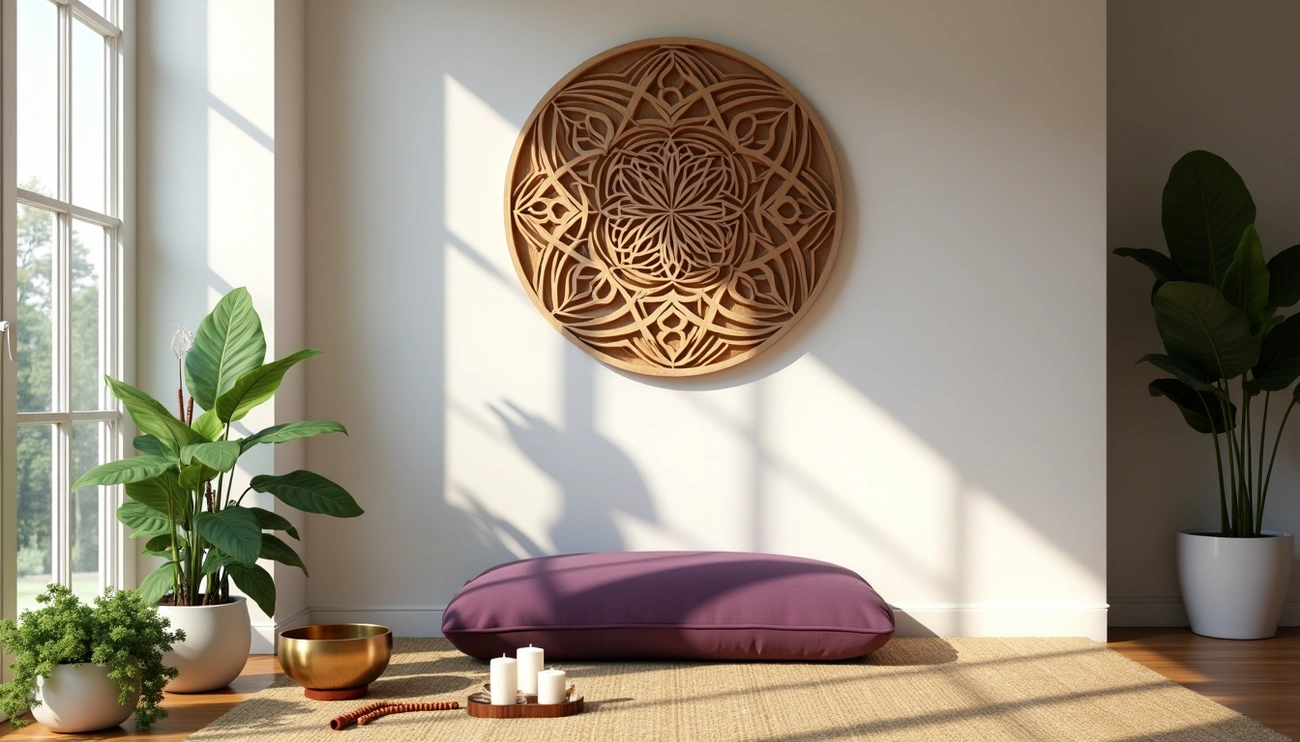
Sacred geometry artworks have captivated people for more than 6,000 years. The Flower of Life first appeared in ancient Egypt’s Temple of Osiris at Abydos. These intricate patterns go beyond cultural boundaries and show up in civilizations of all types – from Egyptian temples to Mayan ruins. Each culture recognized the beauty woven into these mathematical designs.
Sacred geometry symbols work with our consciousness in fascinating ways. The spirit of geometry serves as creation’s fundamental blueprint. These patterns organize energy at every scale, from tiny cells to massive galactic spirals. Sacred geometry means more than just beautiful designs. Hindu meditation practitioners believe symbols like the Sri Yantra lead to deeper awareness. The 64-Tetrahedron Grid links to our DNA structure, which uses exactly 64 codons. Let’s take a closer look at how these ancient visual traditions can enhance your modern meditation practice.
Why sacred geometry resonates with the modern mind
“The harmony of the world is made manifest in Form and Number, and the heart and soul and all the poetry of Natural Philosophy are embodied in the concept of mathematical beauty.” — D’Arcy Wentworth Thompson, Biologist, Mathematician, Author of ‘On Growth and Form’
Sacred geometry artworks give our modern minds something they naturally crave in this ever-changing, complex world—order within chaos. These ancient patterns speak to us at a basic level that surpasses time and cultural boundaries. They provide visual anchors when reality feels disorienting.
The search for harmony in a chaotic world
Sacred geometry’s modern appeal goes beyond pure esthetics—it’s deeply psychological. Studies show that looking at fractal patterns creates a perfect balance between “increased arousal” and “decreased tension.” These patterns satisfy our need for both complexity and relaxation [1]. Our eyes face constant bombardment from unnatural visual stimuli. Mathematical patterns bring relief by matching nature’s built-in organization.
Digital environments strain our eyes and minds. Scientists discovered that fractal installations similar to nature can lower stress levels by reducing this strain [1]. Modern architects and designers have started using sacred geometric principles in living and working spaces, and with good reason too.
Sacred geometry works as a powerful mindfulness tool in our busy lives. People can add these patterns through jewelry, artwork, meditation, or home décor [2]. One researcher puts it well: “In the ever-changing, chaotic world, sacred geometry’s principles remind us to seek balance in our lives” [3].
Geometry as a bridge between science and spirit
Sacred geometry stands out because it connects scientific understanding with spiritual insight. These patterns don’t force us to pick between logical and intuitive knowledge—they bring them together.
Sacred geometry shows up in scientifically observable phenomena. Ancient yantra’s spiral patterns appear in galaxies, DNA structures, and weather systems. These forms also speak a “soul language” that surpasses conscious understanding [4]. Researchers call this dual nature a “quantum bridge” between science and spirituality [5].
Modern spiritual practitioners find these geometric patterns help them reach deeper meditation states. Live documented effects of viewing these patterns—from lower stress to better focus—give us solid reasons to welcome this ancient practice.
Geometry’s spirit works like a universal language that everyone understands, whatever their background. One expert explains it perfectly: “Sacred geometry is not merely a field of curiosity but a vibrant spiritual heritage that pervades various aspects of human existence” [6]. This heritage continues to solve modern challenges effectively.
The meditative power of sacred geometry symbols
“The Fibonacci Sequence turns out to be the key to understanding how nature designs… and is… a part of the same ubiquitous music of the spheres that builds harmony into atoms, molecules, crystals, shells, suns and galaxies and makes the Universe sing.” — Guy Murchie, Author of ‘The Seven Mysteries of Life: An Exploration of Science and Philosophy’
Sacred art’s geometric patterns do more than catch our eye—they reshape our neural pathways. These ancient symbols create a direct path to our deepest consciousness, which makes them powerful tools for meditation.
How does sacred geometry work in the mind?
Our minds process sacred geometry through a fascinating neurological journey. The brain responds to these symmetrical patterns by creating a balance between “increased arousal” and “decreased tension.” This satisfies our need for complexity while keeping us calm [7]. These symbols speak directly to our intuition and emotions by bypassing intellectual filters.
The patterns cut through mental noise and create a sense of simplicity that feels both fresh and familiar [8]. Our brains naturally recognize patterns—we spot something that looks “off” right away, just as we hear a wrong note in music.
The significance of sacred geometry in spiritual traditions
Sacred geometry exceeds cultural boundaries and works as a visual language that links us to universal principles [9]. The mandala in Hinduism (meaning “sacred circle” in Sanskrit) represents the womb of creation and life’s cyclical nature [10]. Buddhist practitioners also use these symbols to reach deeper awareness states.
These geometric patterns serve as gateways to understanding divine creation [7]. Many traditions believe that studying these forms reveals cosmic truths about our connection to all life.
What are the sacred geometry symbols used in meditation?
Meditation practices commonly use several powerful symbols:
- Sri Yantra: Nine interlocking triangles form this symbol (four pointing upward for masculine energy, five downward for feminine energy). Meditation with this symbol realigns energy, removes obstacles, and speeds up manifestation [9].
- Flower of Life: This symbol holds creation’s patterns and shows how everything connects. Focus on it during meditation helps activate life force energy [11].
- Merkaba: Two intersecting tetrahedrons create this three-dimensional star symbol. It balances body energies and helps connect with higher dimensions [11].
These symbols work as focal points that quiet the mind. They create a visual anchor for consciousness, similar to how mantras work with sound [12].
Artists and artworks that embody sacred geometry
Modern artists give new life to ancient geometric traditions by turning sacred patterns into powerful contemporary artworks. Art galleries, museums, and digital marketplaces showcase these artists who blend mathematical precision with spiritual depth.
Zarah Hussain and Islamic geometric art
British artist Zarah Hussain leads the vanguard of contemporary sacred geometry art. She combines traditional Islamic patterns with advanced digital techniques. Her journey began when she asked her teacher about her family’s artistic heritage in Kashmir [13]. This led her to complete her MA at the Prince’s Foundation School of Traditional Arts in London.
Hussain’s innovative work connects spirituality, technology, and art. Her artistic practice grew from painting to cover animation, sculpture, and digital projection. She became “the first artist to explore how algorithms could be used to animate Islamic pattern” [14]. Her installations demonstrate how ancient patterns thrive in modern settings. Notable works include “Numina,” a large-scale sculpture with digitally animated 3D surface, and “Magic Carpet,” which projected animated geometry onto the William Morris gallery exterior.
Contemporary mandala and yantra creators
Traditional yantras—sacred diagrams containing a divine being’s essence—find new expressions through today’s artists. These geometric compositions serve as meditation tools. They feature squares with T-shaped portals, circles, lotus petals, and interlocking triangles centered around the mystical point or “bindu” [15].
Artist Sanford Biggers blends contemporary art with traditional mandalas. His work “Mandala of the B-Bodhisattva II” started as a breakdance floor [16]. Street artist Arthur Louis creates mandala designs of Buddhist lotus flowers on urban surfaces. South African artist Alex Hamilton adds vibrant color to his meditative geometric works [17].
Digital sacred geometry art and NFTs
Digital technology opens new possibilities for sacred geometry artworks. Artists now create NFT collections with sacred geometric designs [18]. Platforms like Stargaze blockchain host collections such as “Genesis Eve by creator.geo of Sacred Geometry” [19].
Digital artist Colin Fleming creates 2D wall art “inspired by the natural world and its divine elements.” His work incorporates sacred geometry, the golden ratio, and fractals [20]. Sacred Geometry Art websites now showcase artists of all types who work in painting, sculpture, digital art, and jewelry [21].
How to use sacred geometry in your meditation practice
Sacred geometry in meditation turns abstract visual symbols into powerful tools that deepen your practice. You can create a bridge between visual stimulation and inner awareness by actively working with these ancient patterns instead of just looking at them passively.
Setting intention with geometric visuals
Your meditation can start with a sacred geometry symbol that appeals to your current needs. The Flower of Life shows interconnectedness, which makes it perfect to encourage unity. The Merkaba (two intersecting tetrahedrons) helps balance upward spiritual connection with downward earth grounding [22]. You should pick a printout of your chosen symbol or picture it in your mind before meditation. Look at the pattern and set a clear intention – whether you want harmony, spiritual growth, or just mental clarity.
Creating a visual altar or meditation wall
The meaning of “altar” comes from “high place,” which reflects its sacred role in spiritual practice [23]. Pick a special space in your home to arrange sacred geometry artworks as focal points. You might want to add:
- Earth elements (plants, crystals, stones)
- Fire elements (candles)
- Sacred geometry artworks or prints [23]
Your space should match your goals—whether you seek protection, manifestation, or spiritual growth [23]. Keep the area clean and energetically fresh because “a clean fresh sacred space encourages good energy” [23].
Combining sacred geometry with sound or breath
Sound vibrations go together naturally with geometry. Some musical notes match the mathematical formulas behind sacred geometric shapes when mapped out [4]. You can try these during meditation:
- Singing bowls placed in geometric arrangements
- Sacred patterns forming with each breath cycle in your mind
- Chanting while you look at geometric symbols
This combination creates what practitioners call “harmonic resonance” that aligns your cellular structure with universal patterns [4].
Daily rituals using sacred geometry art
Your relationship with sacred symbols can change through consistent daily practices. Place sacred geometry artworks in your meditation or living spaces [3]. Spend 5-10 minutes each day on gazing meditation (Trataka) with a yantra or mandala. Let the pattern guide you into a meditative state [24]. Drawing or coloring these patterns yourself works as a practical meditation technique that many people find grounding [6].
Conclusion
Sacred geometry is one of humanity’s most enduring visual languages that speaks to us across millennia with perfect mathematical harmony. These ancient patterns exceed mere decoration and serve as doorways to deeper consciousness. The spirit of geometry gives modern minds something vital – order within chaos, a bridge between science and spirituality, and a visual anchor for our scattered attention.
People often start with sacred geometry through its visual beauty and later find its deep meditative uses. My personal journey with these symbols has created a sense of coherence in my practice that words alone cannot match. The Flower of Life, Sri Yantra, and Merkaba do more than please the eye – they reshape our neural pathways when we contemplate them.
Modern artists like Zarah Hussain show these patterns are still powerful today, not as museum pieces but as living traditions that grow with our changing world. Their work proves sacred geometry belongs in ancient temples and digital spaces alike.
On top of that, the practical uses we’ve covered – setting intentions with specific symbols, creating visual altars, combining geometry with sound – are a great way to get started for anyone interested in this tradition. Sacred geometry’s beauty lies in its dual nature: mathematically precise yet spiritually vast, ancient yet forever relevant.
Sacred geometry teaches us that wisdom doesn’t always come through words. The deepest truths often emerge when we silently contemplate perfect forms that mirror both the cosmos and our inner nature. These patterns help us see ourselves as part of something greater – a realization that changes our meditation practice and our entire experience of being alive.
FAQs
Q1. What is sacred geometry and how does it relate to meditation? Sacred geometry refers to geometric patterns and shapes that have spiritual significance across various cultures. In meditation, these patterns serve as powerful visual tools to focus the mind, induce calm, and facilitate deeper states of consciousness.
Q2. How can I incorporate sacred geometry into my daily meditation practice? You can integrate sacred geometry into your meditation by focusing on specific symbols during your practice, creating a visual altar with geometric artworks, or combining geometric visualizations with breathing exercises or sound healing techniques.
Q3. What are some common sacred geometry symbols used in meditation? Popular sacred geometry symbols for meditation include the Sri Yantra (interlocking triangles), the Flower of Life (overlapping circles), and the Merkaba (intersecting tetrahedrons). Each symbol is believed to have unique energetic properties and meditation benefits.
Q4. Are there any scientific benefits to using sacred geometry in meditation? Studies have shown that viewing fractal patterns, which are often present in sacred geometry, can create a balance between increased arousal and decreased tension in the brain. This can lead to stress reduction, enhanced focus, and a sense of harmony.
Q5. How are contemporary artists incorporating sacred geometry into their work? Modern artists are blending traditional sacred geometry with digital techniques, creating immersive installations, animations, and even NFTs. Some artists, like Zarah Hussain, use algorithms to animate Islamic patterns, while others incorporate sacred geometry into street art, sculptures, and digital projections.
References
[1] – https://pmc.ncbi.nlm.nih.gov/articles/PMC8416160/
[2] – https://holisticlakewood.com/sacred-geometry-understanding-the-interconnectedness-of-nature-and-health/
[3] – https://decords.com/ru/products/sacred-geometry-mandala-wall-art-decal-43412
[4] – https://www.innerbalance-healing.com/posts/sacred-geometry-and-sound-healing
[5] – https://papers.ssrn.com/sol3/papers.cfm?abstract_id=3183048
[6] – https://retreathub.com/using-sacred-geometry-in-your-everyday-life/
[7] – https://www.enhancedyantraenergy.com/blog/sacred-geometry-and-its-influence-on-human-consciousness
[8] – https://community.thriveglobal.com/sacred-geometry-explained-and-how-it-can-improve-our-daily-life/
[9] – https://www.rareearthgallerycc.com/blog-entry/91/introduction-to-sacred-geometry?srsltid=AfmBOop2S-eC4qOiU4JnT_YwyTZa6z5Cdmdfj2pEBkfFivbA7HoBq9GE
[10] – https://weclustr.com/the-role-of-sacred-geometry-in-ancient-cultures-and-traditions/
[11] – https://www.gaia.com/article/7-sacred-geometry-symbols
[12] – https://yogainternational.com/article/view/sacred-geometry-yantras-for-meditation/?srsltid=AfmBOooNFZ1vm9zP3DIDPz784QO9ep8_jFNLohAh6sK94-sNE1gNUlBr
[13] – https://artuk.org/discover/stories/sacred-geometry-zarah-hussain-and-islamic-design
[14] – https://www.grosvenorgallery.com/artists/314-zarah-hussain/overview/
[15] – https://www.artgallery.nsw.gov.au/collection/works/11.2006/
[16] – https://magazine.art21.org/2012/03/23/sanford-biggers-contemporary-mandala-and-the-hip-hop-ethos/
[17] – https://gigazarawatts.wordpress.com/2017/03/23/artist-research-mandalas/
[18] – https://www.pinterest.com/pin/nft-art–119134352634606865/
[19] – https://www.forbes.com/digital-assets/nfts/genesis-eve-by-creator-geo-of-sacred-geometry-genesis-eve-by-creator-geo-of-sacred-geometry/
[20] – https://www.saatchiart.com/art/Digital-Sacred-Geometry/1041910/10361063/view?srsltid=AfmBOoqr4nzp4iFa4kyxhKB22FfTPDpkuIeEf7-S1c8PUwTyA9FUz1UY
[21] – https://www.sacredgeometryart.com/
[22] – https://destinationdeluxe.com/healing-with-sacred-geometry/
[23] – https://fairyleoniescrystals.com/blogs/news/creating-sacred-space-setting-up-an-altar?srsltid=AfmBOoqPx95sHVBiucrNZAD0tjPf170wOHOzGR2xncxXosCpRWorvF9X
[24] – https://journeythroughmeditation.com/blog/2025/3/14/symbols-in-meditation-how-mandalas-and-yantras-can-guide-your-practice
Leave a Reply