
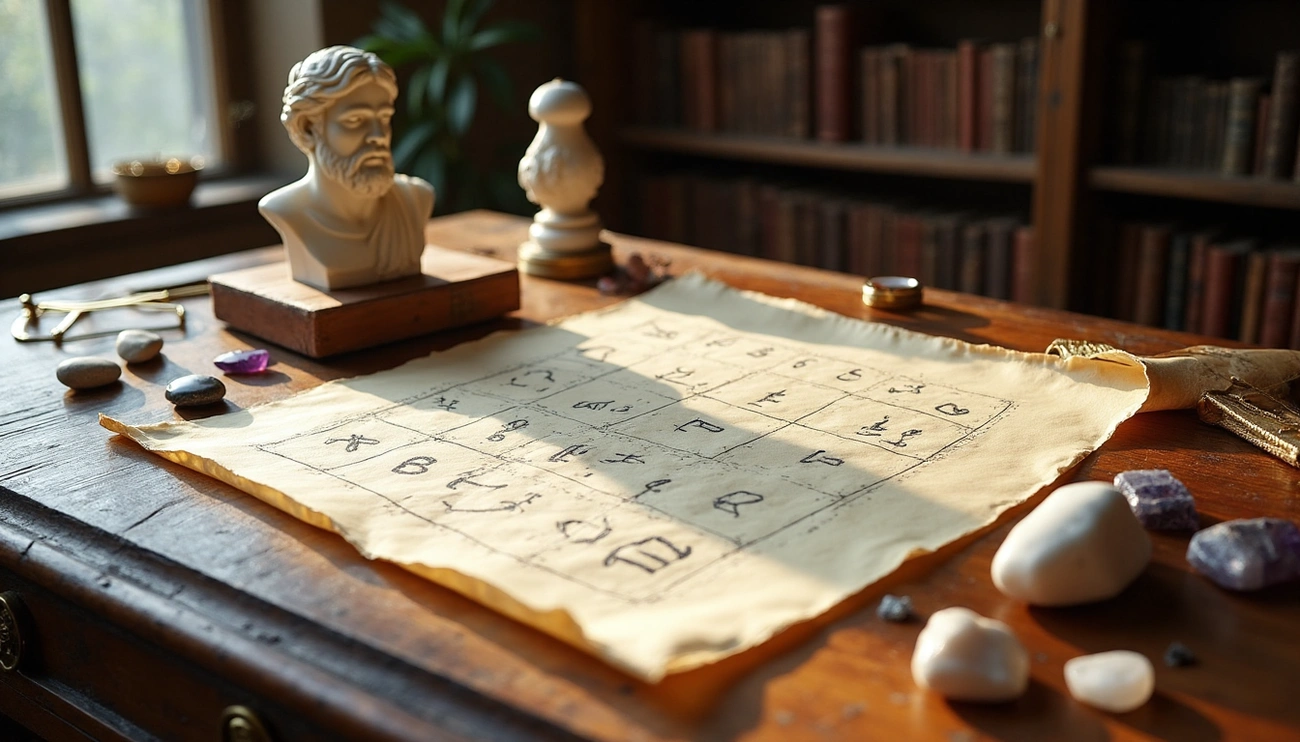
Pythagorean numerology has captivated people for over 2,500 years. The Greek philosopher and mathematician Pythagoras developed this mystical system in the 6th century BC. The system remains the most widely used numerology method in the Western world and has shaped various secret societies like the Rosicrucians and Free Masons throughout history.
The Pythagorean system creates a unique framework that connects letters to numbers. Each letter in the modern Latin alphabet receives a numerical value from 1 to 9. This systematic approach helps calculate five essential numbers: Life Path, Name, Soul, Personality, and Birthday. The system’s treatment of master numbers 11 and 22 stands out because these numbers retain their original form due to their powerful energy and meaning. This piece explains Pythagorean numerology’s number meanings and demonstrates how these time-tested calculations can reveal insights about your character and life’s path.
The Origins and Philosophy of Pythagorean Numerology
“Everything is numbers and to know numbers is to know thyself.” — Pythagoras, Ancient Greek philosopher, mathematician, and founder of Pythagoreanism
The ancient roots of pythagorean numerology can be traced to a mysterious figure. His teachings changed our understanding of numbers and their connection to reality forever.
Who was Pythagoras?
Pythagoras, born around 570 BC on the Greek island of Samos, was much more than a mathematician. He traveled through Egypt, Babylonia, and possibly Persia before starting his famous school in Croton, Italy around 530 BC. These journeys exposed him to various mathematical and spiritual traditions [1]. Unlike today’s scholars, he saw mathematics and spirituality as deeply connected parts of understanding the universe.
Pythagoras never wrote down his teachings. His students learned them orally and took vows of secrecy at his semi-religious school [2]. This secretive nature made his legacy mysterious. His life came to a dramatic end around 495 BC when political enemies attacked and burned his school [3].
How numerology evolved from ancient teachings
Pythagorean numerology started as what Greeks called “isopsephy.” This system gave numerical values to letters and words to uncover hidden meanings [4]. The practice grew during the Hellenistic period after Alexander the Great’s conquests (336-323 BCE) [4].
The pythagorean system faced both suppression and revival throughout history. Greek Orthodox circles kept numerical mysticism alive after Christianity became dominant [4]. Arab alchemists like Jabir ibn Hayyan were influenced by pythagorean numerology. They based their experiments on numerical patterns from Arabic language [4].
Interest in the pythagorean system sparked again during the Renaissance. Philosophers like Cornelius Agrippa (1486-1535) believed everything contained numerical values with magical transcendental meaning [1].
Why numbers were seen as spiritual symbols
The pythagorean system had a revolutionary idea at its core. Numbers weren’t just mathematical tools – they were reality’s fundamental building blocks. Pythagoras famously said “Number rules the universe” [1].
Pythagoreans found that musical harmony matched simple numerical ratios. A string half as long makes a perfect octave, while two-thirds creates the fifth [5]. This link between mathematics and music pointed to a divine cosmic order.
Each number held specific symbolic meaning in the pythagorean letter chart tradition. The number 1 (monad) stood for unity and divine origin. Number 2 represented duality and matter, while 3 meant harmony and perfection [6]. The number 10 was sacred to Pythagoreans. It contained the sum of 1+2+3+4 and appeared in their holiest symbol—the tetractys [6].
Pythagoras’ numerology wasn’t just about seeing the future. It helped people understand the mathematical harmony in everything—a revolutionary idea that shapes spiritual and mathematical thinking even today.
Understanding the Pythagorean System
Pythagorean numerology uses a systematic approach that converts letters into meaningful numbers. This time-tested practice helps us learn about personality, potential, and life paths through specific calculations.
How the Pythagorean numerology chart works
Numbers serve as basic building blocks of reality in the Pythagorean system. This tradition shows how numbers affect our lives and carry distinct vibrations. Numerology goes beyond simple fortune-telling and helps us understand mathematical patterns that shape our existence.
The system calculates five core numbers from your birth date and name: Life Path Number, Soul Urge Number, Expression Number, Personality Number, and Birthday Number. Each number reveals a unique aspect of your character and destiny. To cite an instance, your Life Path Number comes from your birth date and points to your life’s purpose and upcoming opportunities.
Pythagorean letter chart: assigning numbers to letters
The letter-number correspondence chart forms the base of Pythagorean system numerology. Each letter of the English alphabet gets a number from 1 to 9 in sequence:
| 1 | 2 | 3 | 4 | 5 | 6 | 7 | 8 | 9 |
|---|---|---|---|---|---|---|---|---|
| A | B | C | D | E | F | G | H | I |
| J | K | L | M | N | O | P | Q | R |
| S | T | U | V | W | X | Y | Z |
The calculation of numerological values happens by converting letters to their matching numbers and adding them together. The name “John” becomes 1(J)+6(O)+8(H)+5(N)=20, which reduces to 2+0=2. This process shows the Pythagorean numerology number meanings linked to your name.
The role of master numbers 11 and 22
All but one of these numbers in Pythagorean numerology chart interpretations reduce to a single digit. Master numbers 11 and 22 stand apart with their special significance.
Master number 11, known as the “Intuitive Illuminator,” represents spiritual insight, intuition, and enlightenment. People with this number show heightened sensitivity and inspirational qualities, yet they might face anxiety.
Master number 22, called the “Master Builder,” blends the practicality of number 4 with enhanced potential. People with this number show exceptional leadership and organizational skills that help them turn dreams into reality.
Pythagorean Numerology Number Meanings
“If you only knew the magnificence of the 3, 6, and 9, then you would have a key to the universe.” — Nikola Tesla, Serbian-American inventor, electrical engineer, and futurist
Numbers in Pythagorean numerology carry unique vibrations and qualities that clarify different aspects of our personality and life experience. These numerical meanings help us decode the patterns that shape our existence.
Number 1: Leadership and independence
The number 1 symbolizes the principle of beginning and serves as the foundation of all numbers. In Pythagorean system numerology, this number represents leadership, strength, and innovation. People influenced by number 1 show traits of independence, ambition, and originality. They know how to lead naturally and have strong willpower, which makes them great at taking initiative and creating new paths. Their self-confidence and determination help them pursue goals effectively. Even with these positives, too much of number 1’s energy can turn into self-centeredness, while people lacking this energy might find it hard to make decisions.
Number 2: Harmony and sensitivity
Number 2 represents the principle of duality and balance. This number embodies harmony, cooperation, and diplomacy. People with strong 2 energy excel as peacemakers and can bring people together during conflicts. Pythagorean numerology connects 2 with the Moon, which represents intuition and the subconscious mind. These individuals become caring partners who value harmony in relationships above everything else. They listen well and show empathy, which makes them valuable in jobs that need people skills.
Number 3: Creativity and expression
Pythagoras saw number 3 as special because it’s the only number equal to the sum of all numbers below it (1+2=3). This number represents creativity, expression, and optimism. People influenced by 3 communicate well and have artistic talents. They express themselves naturally through art, music, writing, or speaking. Their enthusiastic, youthful energy brings joy and inspiration to others.
Number 4: Stability and discipline
Pythagorean numerology charts show 4 as a symbol of stability, practicality, and organization. This number links to the physical realm and represents the four elements and seasons. People with strong 4 energy stay reliable, notice details, and maintain discipline. They create structure and build solid foundations well. Their methodical approach and sense of responsibility make them dependable always.
Number 5: Freedom and adaptability
Number 5 symbolizes freedom, change, and adventure. This dynamic energy shows progression and passion. Pythagorean letter charts connect 5 to marriage as it combines the female number 2 with the male number 3. People influenced by 5 adapt easily, stay curious, and love new experiences. Their natural resourcefulness helps them thrive when things change.
Number 6 to 9 and master numbers 11, 22
Each remaining single digit carries important meanings: 6 shows responsibility and nurturing; 7 represents analysis and spirituality; 8 stands for power and material success; 9 reflects compassion and humanitarianism.
Master numbers 11 and 22 hold special meaning in Pythagorean numerology. Number 11, known as the “Intuitive Illuminator,” brings heightened spiritual insight and intuition but may create emotional challenges. Number 22, the “Master Builder,” combines practical skills with visionary potential to turn ambitious dreams into reality.
Core Numbers in Your Numerology Profile
The pythagorean system numerology creates your personal profile from several core numbers. These numbers work together to show your character, talents, and life’s trip. Each number lights up a different part of who you are and the path ahead.
Life Path Number
Your Life Path Number sits at the center of your numerology profile. We calculated this from your full birth date by reducing your birth month, day, and year to single digits and adding them together. To cite an instance, February 27, 1976 would be 2 + 9 + 5 = 16/7 [7]. This number shows your life’s purpose, natural traits, and the opportunities you’ll meet along the way. Many experts call it the most significant core number that shapes your life’s path, challenges, and opportunities [8].
Expression or Destiny Number
Your Expression Number (some call it Destiny Number) shows the talents, abilities, and shortcomings you brought with you [9]. This number reveals the person you want to become. The calculation uses numerical values for each letter in your full birth name from the pythagorean letter chart. The result reduces to a single digit unless it’s a master number. Your ultimate destiny and potential achievements become clear through this number [10].
Soul Urge Number
The Soul Urge Number, also known as Heart’s Desire Number, reveals why you do what you do [11]. This number comes from the vowels in your full birth name and shows your deepest desires, what you like and dislike, and what makes you feel complete [12]. Your life choices heavily depend on this number, which explains those gut feelings you can’t always state clearly [13].
Personality Number
The consonants in your full birth name create your Personality Number, which filters what you show to others [14]. This number represents how people notice you before they really know you – like a mask for public appearances [15]. You use these traits when meeting new people and choose who gets close to you based on this number [14].
Birthday Number
Your Birthday Number is just the day you were born, kept as is without reduction to a single digit [16]. This simple number helps you find natural talents that help you on your Life’s Path [17]. People born on the 8th are great at setting goals, while those born on the 2nd naturally find balanced solutions [16].
Challenge and Maturity Numbers
The Challenge Number shows weaknesses you need to overcome. The calculation uses differences between your birth date digits to identify four challenges that come up at different life stages [18]. The Maturity Number (or Ultimate Number) comes from adding your Life Path and Expression numbers. This number shows how your life goals become clearer as you grow older [18].
Conclusion
Pythagorean numerology gives us an amazing glimpse into self-discovery through ancient mathematical wisdom. This piece explores how Pythagoras reshaped numbers from basic math concepts into deep spiritual symbols. These symbols show different aspects of our character and destiny.
Numbers do much more than help us calculate. They act as keys to deeper meanings about our personality traits, life paths, and possible challenges. The Pythagorean letter chart offers a simple system to convert names and birth dates into meaningful numerical values. Each number carries specific vibrations and qualities.
Your core numbers create a detailed numerological profile that lights up different parts of your life’s trip. Life Path, Expression, Soul Urge, Personality, and Birthday numbers don’t just reveal who you are now. They point to who you might become.
Master numbers 11 and 22 hold special spiritual significance and potential. These numbers bring bigger challenges but open up more possibilities for people who carry their energy.
Pythagoras believed numbers ruled the universe by creating mathematical patterns that shape our existence. His ancient wisdom still strikes a chord today because it speaks to our need to understand ourselves and find meaning. His system, developed over 2,500 years ago, stays relevant because it taps into universal principles that exceed time.
The Pythagorean system helps you learn about yourself, whether you see numerology as spiritual practice or just an interesting way to view life. Numbers tell your story through their vibrations and meanings. They reveal patterns in your life that might stay hidden otherwise.
Skeptics often find themselves amazed by how accurate their numerological readings turn out to be. Without doubt, something powerful happens when you see your personality traits reflected in calculations from your name and birth date.
Pythagoras left us more than a mathematical theorem. He created a system to decode the numerical blueprint of our lives. His ideas live on because numbers, seen through his mystical perspective, show deep truths about who we are and who we could become.
FAQs
Q1. What is the significance of the number 7 in Pythagorean numerology? In Pythagorean numerology, the number 7 represents spirituality and analysis. It’s considered a bridge between the physical (represented by 4) and the spiritual (represented by 3), embodying wisdom, introspection, and a deep connection to the metaphysical realm.
Q2. How did Pythagoras view the relationship between numbers and reality? Pythagoras believed that “all things are numbers,” meaning that numbers were the fundamental building blocks of reality. He saw numbers as governing the properties of all beings and composing the universe’s harmony, attributing to them both mathematical and spiritual significance.
Q3. What are the core numbers in a Pythagorean numerology profile? The core numbers in a Pythagorean numerology profile include the Life Path Number, Expression (or Destiny) Number, Soul Urge Number, Personality Number, and Birthday Number. Each of these numbers reveals different aspects of an individual’s character and life journey.
Q4. What does the number 3 symbolize in Pythagorean numerology? In Pythagorean numerology, the number 3 symbolizes creativity, expression, and optimism. It was considered a perfect number, representing harmony, wisdom, and understanding. People influenced by this number often possess exceptional communication abilities and artistic talents.
Q5. How can beginners start learning Pythagorean numerology? Beginners can start learning Pythagorean numerology by studying the meanings of numbers 1-9, understanding the Pythagorean letter chart, and practicing calculations for core numbers. It’s helpful to read books on the subject, memorize the significance of different numbers, and apply the concepts to your own birth date and name as practice.
References
[1] – https://www.astronumero.org/history-of-numerology/
[2] – https://en.wikipedia.org/wiki/Pythagoras
[3] – https://www.worldnumerology.com/what-is-numerology/pythagorean-numerology.html
[4] – https://en.wikipedia.org/wiki/Numerology
[5] – https://www.britannica.com/topic/number-symbolism/Pythagoreanism
[6] – https://www.samwoolfe.com/2018/06/pythagoras-and-number-symbolism.html
[7] – https://seventhlifepath.com/how-to-calculate-your-life-path-number/
[8] – https://www.mysticmag.com/psychic-reading/pythagorean-numerology/
[9] – https://www.worldnumerology.com/numerology-expression/
[10] – https://astrotalk.com/numerology-introduction/pythagorean
[11] – https://www.worldnumerology.com/numerology-soul-urge/
[12] – https://mattbeech.com/numerology/soul-urge-number/
[13] – https://feliciabender.com/numerology/numerology-the-soul-urge-number/
[14] – https://seventhlifepath.com/how-to-calculate-personality-number/
[15] – https://www.worldnumerology.com/numerology-personality/
[16] – https://www.numerology.com/articles/your-numerology-chart/birth-day-number/
[17] – https://www.worldnumerology.com/numerology-birthday-numbers/
[18] – https://askastrologer.com/articles/pythagoras-numerology/
Leave a Reply