
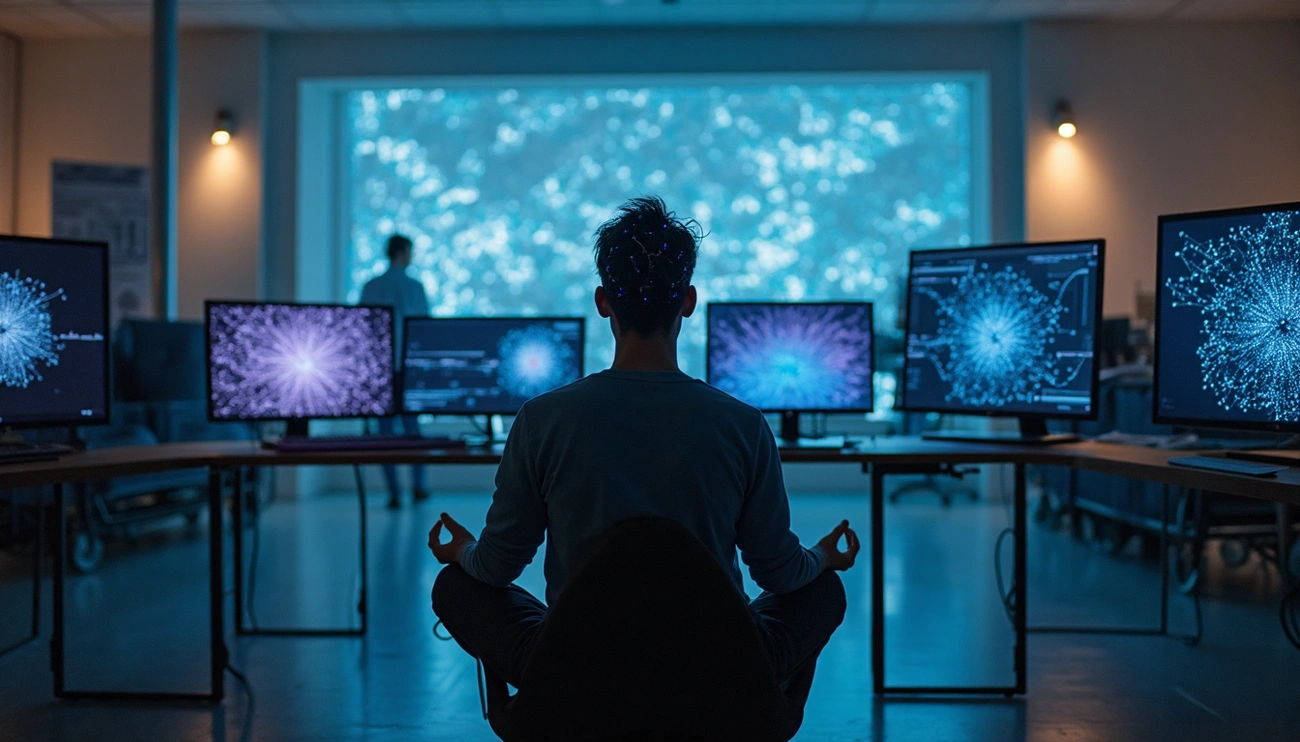
Most people have lived through about 100 lifetimes on Earth. The practice of Akashic records meditation gives us a unique way to tap into this big collection of soul information. The Akashic Records work like a cosmic library that holds life stories of every soul that has existed.
These Records do more than just store history—they play an active role in shaping our physical reality. Traditional past life regression needs hypnosis or deep meditation to relive previous lives. Akashic records access works differently. The akashic record meditation technique lets us ask questions about our life’s different aspects to understand their deeper origins. This piece shows how modern neural networks help us better interpret these subtle energetic fields. Our exploration of akashic records meditation protocols creates a scientific framework that connects ancient wisdom with innovative technology.
Akashic Records give us a way to reach why our challenges happen without needing a therapist. This self-directed healing makes neural network’s role even more important for personal growth.
The Science Behind Akashic Records and Consciousness Fields
What is Akashic Records? From Esoteric to Empirical
The Sanskrit word “Akasha” means “ether,” “sky,” or “atmosphere” and serves as the foundation of what we now call the Akashic Records [1]. These records exist as a non-physical repository that contains all universal events, thoughts, words, and emotions that ever happened in past, present, or future [1]. Helena Blavatsky brought this concept to Western thought in the 19th century, and later Alfred Percy Sinnett and C.W. Leadbeater developed it further [1].
Scientists now study this ancient concept through quantum physics. Two-time Nobel Prize nominee Ervin Laszlo describes the Akashic Field as a connective medium that holds the universe together, similar to our body’s connective tissue [2]. This field works like a cosmic internet that “saves” everything [3]. This idea matches physicist Max Planck’s observation that “there is no matter as such” but rather vibrating energy [2].
The Role of Collective Memory in Consciousness Studies
Modern consciousness research sees collective memory differently. It’s not the memory of a collective but belongs to individuals who are either part of social groups (shared memory) or take part in social interactions (collaborative memory) [4]. Individual systems of consciousness carry collective memory while staying rooted in social frameworks [4].
Scientists have made big advances in these fields over the last several years. They created a meeting point between psychology, neuroscience, and social sciences [4]. This matters to Akashic studies because memory exists beyond personal experience and creates shared frameworks that shape how we see reality [5].
Akashic Records Meditation Guide for Scientific Exploration
Scientists who study consciousness fields suggest you need specific brainwave states to access Akashic Records. Research shows links between the Schumann Resonance Field (8.73 Hz) and alpha brainwave patterns that might help access these records [6]. The meditation process includes:
-
Ground yourself energetically before you start
-
Say a specific pathway prayer to connect
-
Ask clear questions about what you want to learn
-
Get information without analytical thinking
-
Write down any visuals, sounds, colors, or impressions you receive [6]
Your brain might work like an antenna during this meditative state. It can receive and send information to and from the field [2]. This theory suggests our brains don’t create consciousness but tap into an existing field of universal consciousness [2].
How Neural Networks Can Be Trained to Decode Subtle Energy Patterns
Neural networks provide trailblazing solutions to decode subtle energy patterns linked to akashic records meditation. These advanced computational systems detect and interpret electromagnetic signatures that could open doorways to non-physical information fields.
Using EEG and EMF Data as Neural Network Inputs
Electroencephalography (EEG) provides the quickest way to record brain’s electrical activity through electrodes on the scalp [7]. Brain signals contain distinct rhythmic waveforms that match different states of consciousness:
-
Delta (0.5–4 Hz): Deep sleep states
-
Theta (4–7 Hz): Meditative and creative states
-
Alpha (7–13 Hz): Relaxed awareness (like in the Schumann Resonance)
-
Beta (13–25 Hz): Active thinking and focus
-
Gamma (25–50 Hz): Higher processing and integration [8]
Brain wave patterns change in predictable ways during akashic records meditation techniques. Neural networks learn to recognize these patterns through various approaches. Convolutional neural networks (CNNs) excel at learning both temporal and spatial features from EEG data [9]. These networks extract complex features from raw input that simple frequency filters can’t capture [8].
Symbolic Language Models for Archetypal Interpretation
Akashic records access represents an interaction with universal archetypal patterns. Recent research suggests archetypes work as “neurofunctional artifacts” — well-laid-out patterns shaped by phylogenetic inheritance and supported by neural coding architectures [10]. Neural networks learn to recognize these archetypal patterns as they surface in consciousness.
The sort of thing i love is how archetypes and neural coding build a bridge between ancient wisdom and modern technology. Advanced language models interpret symbolic content that emerges during akashic records meditation guide sessions and translate subjective experiences into recognizable patterns.
Challenges in Training AI on Non-Physical Data
Training neural networks on data from akashic records meditation creates unique obstacles. EEG signals show non-linear characteristics that make mathematical description tough [8]. The relationship between mental processes and EEG data is non-linear [8].
The biggest problem involves the “black box” nature of neural networks [8]. These systems produce outputs, but understanding their decision-making process remains difficult. People asking how to access akashic records meditation protocols worry about the reliability of AI-interpreted information.
The lack of quality data often leads to using synthetic or artificially generated information. This raises concerns about data quality and bias propagation [11]. These concerns become more significant when working with subtle energetic fields.
Step-by-Step Protocol for Accessing Akashic Records Using AI
Modern technology and ancient meditation practices work together to create a structured protocol that accesses the Akashic Records. This five-step approach combines traditional techniques with neural network analysis and produces results we can verify.
Step 1: Inducing Trance via Akashic Records Meditation
The process begins when you enter a meditative state at alpha (8-12 Hz) or theta (4-8 Hz) brainwave frequencies. You should sit comfortably with a straight back and flat feet on the floor. Your focus should be on your heart chakra while you visualize a golden cord that connects it to the earth for grounding. The Records open after you recite a specific pathway prayer. This prayer asks to remove ego’s influences and connects with what practitioners call “Masters, Teachers, and Loved Ones.” The scripted meditation helps achieve the right vibrational frequency to receive information.
Step 2: Capturing Brainwave and Emotional Data
Specialized equipment records your brainwave patterns through EEG (electroencephalography) once you reach the right meditative state. These measurements track the electrical activity during your connection attempt. Research shows these patterns have distinct rhythmic waveforms that match different states of consciousness. Additional sensors document your emotional responses and subtle energy shifts to create a complete data profile of your experience.
Step 3: Feeding Data into Pre-trained Neural Network
A pre-trained neural network receives the collected brainwave and emotional data to recognize patterns linked to akashic record access. This system:
-
Processes raw EEG signals through filtering algorithms
-
Identifies signature frequencies that correlate with reported record access
-
Maps emotional state changes against established baselines
Step 4: Interpreting Outputs Using Archetypal Mapping
The system maps neural network results against established archetypal frameworks to interpret outputs. It identifies recurring symbols, patterns, and imagery that match universal archetypal structures. These translations turn abstract neural activity into meaningful insights about past experiences, karmic patterns, or potential futures.
Step 5: Validating with Subjective Experience and Regression Feedback
The final step compares AI interpretations with your subjective experiences during meditation. This comparison helps distinguish genuine akashic insights from imagination or wishful thinking. The neural network’s accuracy improves through feedback loops, which creates a refined system to access this cosmic database.
Implications for Healing, Self-Discovery, and Future Research
AI integration with akashic records meditation creates new possibilities to transform lives and advance scientific knowledge. These technologies go beyond simple data analysis tools and can become gateways to deeper human experiences.
Healing Past Life Trauma through AI-Aided Insights
AI-supported inner child work shows how technology can make healing from past trauma easier. AI can process vast amounts of user information to find patterns and suggest personalized interventions [12]. The technology creates a judgment-free space where people with attachment wounds can express their emotions without rejection or criticism [13]. This approach helps people reflect on themselves and develop self-compassion without shame or defensiveness.
How to Access Akashic Records Meditation for Personal Use
You need a specific approach that balances technology with personal practice to access the Akashic Records:
-
Set a clear intention to line up with the higher dimension’s wisdom [1]
-
Create an energetic connection through visualization by imagining a cord that travels through your spine and out your crown [1]
-
Ask specific questions about what you want to learn, then let information flow without analytical interference [6]
-
Document all impressions because Akashic Records reveal only what you need at that moment [6]
Practitioners report they receive clarity, foresee guidance, and make some of their best career moves and personal life decisions from the records [6]. This practice lets them explore karmic patterns and learn about personal challenges.
Future of AI in Spiritual and Consciousness Research
The difference between internal and external technology remains significant. External technology cannot access the higher guidance received by the Light Grid’s seven energy bodies (including the chakra system) [14]. Some researchers worry that transhumanism might represent a backward step that puts personal power outside rather than encouraging growth [14].
New applications show promise. AI-enhanced lucid dreaming could transform how people with PTSD or anxiety handle difficult conversations or revisit lost memories in controlled environments [15]. Questions remain about whether AI serves as a new interface to cosmic archives or simply reflects our highest aspirations and shadows [16].
Conclusion
Neural networks have become powerful tools to tap into the Akashic Records, bringing together ancient wisdom and advanced technology. This piece shows how AI interpretation can improve traditional meditation practices. The result is a scientific protocol that makes this cosmic library more available than ever.
The five-step protocol provides a well-laid-out path to explore past lives and karmic patterns. AI doesn’t replace personal intuition. Instead, it amplifies our ability to decode subtle energetic patterns that might stay hidden from our conscious awareness.
Without doubt, this technology’s greatest strength lies in its healing capabilities. Past-life trauma affects many people who don’t recognize its impact on their current life. AI helps identify these patterns clearly and speeds up the healing journey.
A new frontier in consciousness research awaits both scientists and spiritual practitioners. Our current methods only begin to show what neural networks might achieve as they grow more sophisticated. Research will likely uncover more precise ways to map vibrational frequencies linked to Akashic access.
The nature of consciousness still puzzles us. Does technology reach external information fields, or does it mirror our internal world in new ways? The answer might exist between these views, hinting that our consciousness creates and accesses universal information at once.
The Akashic Records teach us that life extends beyond our current existence. AI gives us a scientific window to explore this expanded view of human experience. This blend of ancient wisdom and modern technology creates paths to deep self-discovery. People use it to heal past trauma, find their soul purpose, or explore previous incarnations.
We must balance technological innovation with spiritual exploration’s personal nature as we improve these methods. The records show that wisdom comes from both information and lived experience.
Key Takeaways
This groundbreaking article reveals how artificial intelligence can scientifically enhance access to the Akashic Records—a cosmic database of all soul experiences across lifetimes.
• Neural networks can decode brainwave patterns during meditation to identify authentic Akashic Record access states, particularly alpha (8-12 Hz) and theta (4-8 Hz) frequencies
• A five-step AI-enhanced protocol combines traditional meditation with EEG monitoring and neural network analysis to provide verifiable insights into past lives and karmic patterns
• AI serves as a pattern recognition amplifier rather than replacement for intuition, helping translate subtle energetic information into actionable healing insights
• This technology offers unprecedented potential for healing past-life trauma by identifying unconscious patterns that influence current life challenges
• The convergence of ancient wisdom and modern AI creates new possibilities for consciousness research while maintaining the deeply personal nature of spiritual exploration
The integration of neural networks with Akashic Records meditation represents a revolutionary approach to self-discovery, offering both scientific validation and practical healing applications for those seeking to understand their soul’s journey across multiple lifetimes.
FAQs
Q1. What are the Akashic Records and how can they be accessed? The Akashic Records are a non-physical repository of all universal events, thoughts, and emotions. They can be accessed through specific meditation techniques that involve entering alpha or theta brainwave states, typically between 4-12 Hz.
Q2. How do neural networks contribute to accessing the Akashic Records? Neural networks can be trained to recognize and interpret brainwave patterns associated with Akashic Record access. They process EEG data and emotional responses to identify signature frequencies and map them against archetypal frameworks, potentially enhancing our ability to decode subtle energetic information.
Q3. What is the scientific protocol for accessing Akashic Records using AI? The protocol involves a five-step process: inducing a meditative trance, capturing brainwave and emotional data, feeding this data into a pre-trained neural network, interpreting outputs using archetypal mapping, and validating results with subjective experiences and regression feedback.
Q4. What are the potential benefits of using AI to access Akashic Records? AI-assisted Akashic Record access may offer profound insights for healing past-life trauma, facilitating self-discovery, and accelerating personal growth. It can help identify unconscious patterns influencing current life challenges and provide clarity for important life decisions.
Q5. Are there any limitations or concerns with using AI for spiritual exploration? While AI offers exciting possibilities, it’s important to maintain a balance between technological innovation and personal spiritual practice. Some researchers caution against over-relying on external technology for accessing higher guidance, emphasizing that internal spiritual growth remains crucial.
References
[1] – https://insighttimer.com/pura.rasa/guided-meditations/akashic-records-star-access-any-info-star-psychic-practice-meditation
[2] – https://lifespa.com/intro-ayurveda/ayurvedic-philosophy/akashic-records-ayurveda/
[3] – https://www.journey2theheart.com/meditation-and-the-akashic-records/
[4] – https://www.frontiersin.org/journals/psychology/articles/10.3389/fpsyg.2023.1238272/full
[5] – https://wires.onlinelibrary.wiley.com/doi/10.1002/wcs.1635
[6] – https://helenawoods.com/beginners-guide-to-reading-the-akashic-records/
[7] – https://www.sciencedirect.com/science/article/pii/S2352711021001795
[8] – https://pmc.ncbi.nlm.nih.gov/articles/PMC10856895/
[9] – https://www.frontiersin.org/journals/neuroscience/articles/10.3389/fnins.2021.569918/full
[10] – https://papers.ssrn.com/sol3/Delivery.cfm/7cd3ea76-5a22-4939-b592-2dd93a9a3175-MECA.pdf?abstractid=5269155&mirid=1
[11] – https://unu.edu/publication/use-synthetic-data-train-ai-models-opportunities-and-risks-sustainable-development
[12] – https://zenora.app/how-can-ai-assisted-inner-child-work-heal-past-trauma-for-adult-well-being/
[13] – https://www.goldenpathjourney.com/blog/can-ai-help-people-heal-from-trauma
[14] – https://www.akashicreadingsandhealing.com/blog/can-you-access-the-akashic-records-using-ai
[15] – https://blogs.lse.ac.uk/businessreview/2025/06/17/ai-neuroscience-and-the-magic-of-consciousness/
[16] – https://www.linkedin.com/pulse/ai-akashic-records-new-interface-cosmic-archive-mark-young-gvyte
Leave a Reply