
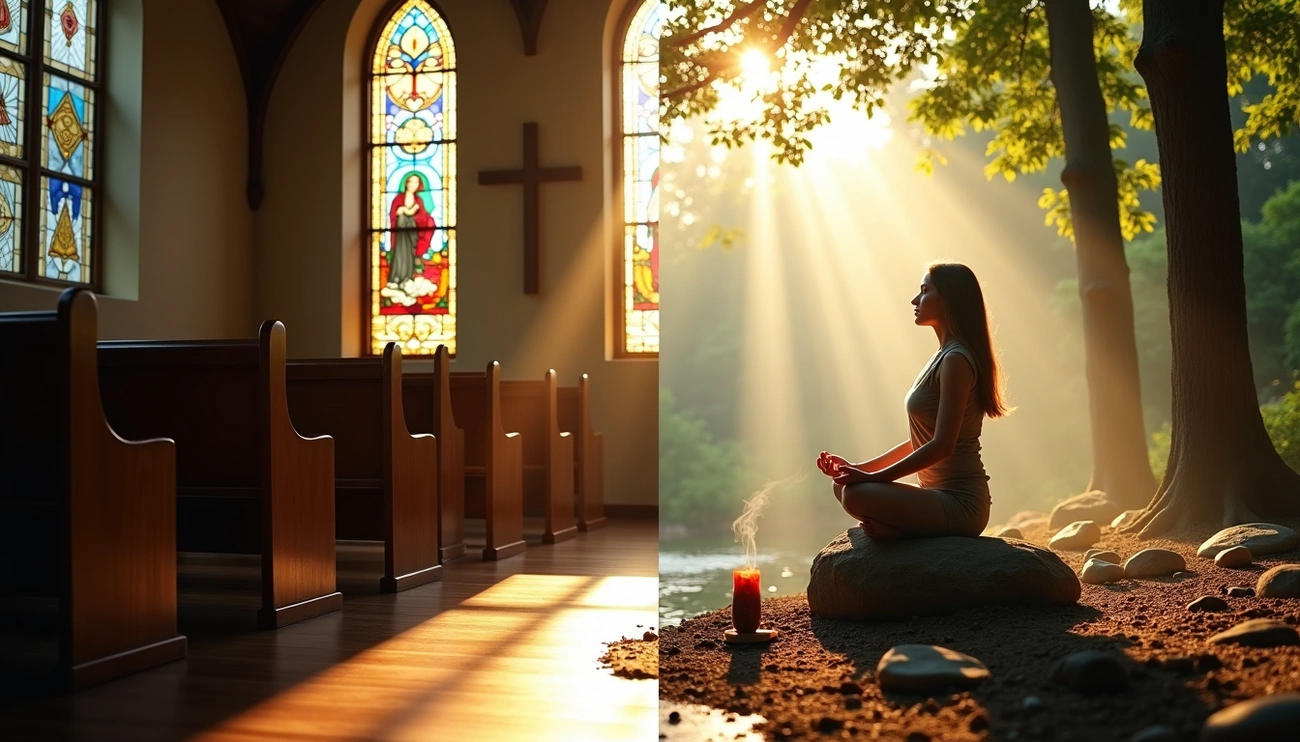
The difference between being spiritual and religious has become one of the most important aspects of American life. More people now craft their own spiritual identities outside traditional religious frameworks. Recent data shows this trend clearly – a 2023 study reveals that 22% of Americans identify as spiritual but not religious (SBNR). This marks a substantial increase from previous decades, as Pew Research Center found only 15% of Americans had no religious affiliation in 2007.
People who identify as spiritual but not religious seek meaningful connections with something greater than themselves through personal practices rather than institutional ones. Their approach embraces spiritual experiences without traditional religious structures. Research shows SBNR Americans tend to be younger and lean toward Democratic political views. They connect with the divine or a higher power through immediate and spontaneous experiences, rather than participating in conventional religious worship.
This piece delves deep into the dynamic relationship between spirituality and religion. You’ll learn why more people choose their own spiritual paths and whether spirituality can exist without religious beliefs. The discussion also covers various challenges critics raise about this approach. Some point out risks of superficiality and insufficient structure in personal spiritual practices.
What does it mean to be spiritual vs religious?
People used the terms “spiritual” and “religious” interchangeably for centuries. These concepts now represent two different approaches to life’s deeper questions. Let me break down what these terms mean and why their difference has become a key feature of our current spiritual world.
Defining ‘spiritual’ and ‘religious’
Religion has a formal definition: “the belief in and worship of a superhuman power or powers, especially a God or gods, and as a particular system of faith and worship” [1]. Religion works as a social institution with hosted beliefs, dogmas, rules, and rituals that members follow. Religious people usually see themselves as part of a community with shared practices and traditions [1].
Spirituality proves harder to define with precision. The dictionary calls it “the quality of being concerned with the human spirit or soul as opposed to material or physical things” [1]. Some see it as “the personal quest for meaning in life” or “anything involved in feeding the soul of the practicing person” [1]. Christina Puchalski, Director of the George Washington Institute for Spirituality and Health, gives a complete definition: “Spirituality is the aspect of humanity that refers to the way individuals seek and express meaning and purpose and the way they experience their connectedness to the moment, to self, to others, to nature, and to the significant or sacred” [2].
This basic difference can be summed up: religion presents a set of beliefs, dogmas and “holy men” as intermediaries between you and Spirit, while spirituality promotes individual autonomy in defining and connecting to Spirit as it fits your heart and mind [3].
How the meanings have evolved over time
Spirituality and religion were once inseparable concepts. Our grandparents practiced their faith through disciplined rituals—lighting incense, reciting prayers, and reading scriptures—without seeing any difference between being spiritual or religious [4]. People rarely questioned their spiritual path back then. They were simply born into it [4].
Christians have debated authority and tradition versus feeling and experience through the centuries. Modern theologians from Friedrich Schleiermacher to William James tried to understand religion itself through experience. They struggled with what makes up “religious experience” [5].
Religion’s dominance has steadily decreased since the European Enlightenment in the 17th century, especially in Western societies. Science’s explanatory power grew and education levels rose. People felt less need to look to hosted religion to understand the world [3]. Scholars now identify two clear types of spirituality: esoteric (inner) pagan religion that finds truth within the human heart, and exoteric (outer) theistic religion that sees truth beyond nature and humanity in a Creator God [4].
Why the difference matters today
This difference between spirituality and religion reflects big changes in how people connect with the sacred. Pew Research shows 22% of American adults call themselves “spiritual but not religious” (SBNR) [4]. These people often view hosted religion more negatively than those who identify as both religious and spiritual [4].
The SBNR movement shows a radical alteration from external rules to internal growth. Only 2% of spiritually-but-not-religious Americans attend worship services weekly, compared to 40% of adults who identify as both religious and spiritual [4]. SBNRs tend to see spiritual forces at work in nature—71% believe spirits or spiritual energies exist in natural elements like mountains, rivers, or trees [4].
This difference matters because it addresses deep human needs that traditional religion and scientific materialism can’t fully meet. Many people can’t accept religious dogmas like before. A purely scientific worldview often shows a cold, mechanistic universe that leads to nihilism and lack of meaning [3]. The spiritual-but-not-religious approach tries to fill these gaps by creating space to explore without institutional limits.
“Spiritual” Americans’ top three essential elements of spirituality show this nuanced relationship: “being connected with something bigger than myself” (74%), “being connected with God” (70%), and “being connected with my true self” (64%) [4]. These responses show how today’s spirituality emphasizes connections—with the divine, oneself, and the broader universe—without needing institutional mediation.
The difference between spirituality and religion ended up being about attitude rather than belief content [3]. One commentator put it well: “However you choose to be, spiritual or religious, it should feel comfortable and uplifting for you… Remember that finding spirituality or religion is often a lifelong process” [1].
The rise of the ‘spiritual but not religious’ identity
The “spiritual but not religious” (SBNR) identity has evolved from a small movement into a major cultural force in the last century. This self-description now shows how millions of Americans think about faith and meaning.
Origins of the SBNR movement
The SBNR movement’s roots go back earlier than most people think. The American Mercury first mentioned this term in 1926 to describe the Rotary Club as inclusive, nonsectarian, and “spiritual but not religious” [1]. The Washington Post used this phrase again in 1934 about memorials for Lusitania shipwreck victims [1].
Alcoholics Anonymous helped spread this concept widely. The 12-step program became known as “spiritual but not religious” from the 1950s through the 1970s. It showed people could grow spiritually outside traditional religious structures [1].
Liberal religious groups like the Transcendentalists, Unitarians, and Quakers laid the groundwork for this movement. They valued individual thinking, quiet reflection, meditation, and respect for different religions [1]. People like Ralph Waldo Emerson, Walt Whitman, and Henry David Thoreau shaped a uniquely American spirituality that put personal experience above religious authority [1].
The growth of therapeutic psychology created what anthropologist Victor Turner called a “liminal social space” separate from traditional religion. These therapeutic settings helped people analyze religion as something humans created rather than divine law [1].
Key demographic trends
About 22% of American adults now call themselves spiritual but not religious [1]. These people tend to be younger than religious Americans – 58% are under 50 compared to 45% of religious people [6].
SBNRs have different political views than religious groups. Most of them (60%) support Democrats or lean Democratic, while only 39% of religious Americans do the same [6]. Many SBNRs criticize organized religion – 42% say it creates division and intolerance. Only 12% of religious-and-spiritual adults share this point of view [1].
Though they reject the “religious” label, 45% of SBNRs still belong to a religion. This includes 21% Protestants and 12% Catholics, while 54% have no religious affiliation [1]. Their practices look very different from traditional worship – just 2% go to religious services weekly, compared to 40% of people who are both religious and spiritual [1].
Generational shifts in belief systems
Each new generation shows less connection to religion. Gen Z leads with 34% having no religious ties, more than Millennials (29%), Generation X (25%), Baby Boomers (18%), and the Silent Generation (9%) [7]. Gen Z also has more atheists and agnostics (18%) than Boomers (9%) and the Silent Generation (4%) [7].
Religious participation in childhood has dropped across generations:
-
Baby Boomers: 57% went to weekly religious services as children
-
Millennials: 45% had the same experience
-
Gen Z: Only 40% attended weekly worship growing up [7]
These numbers reflect bigger cultural changes. George Barna’s research shows biblical worldview has dropped for five straight generations, from 12% to 4% today [8]. Just 21% of Gen Z uses the Bible as their main moral guide, lower than older generations [8].
Traditional religion will likely keep declining unless something changes dramatically [8]. This doesn’t mean people are less spiritual – they just prefer personal experiences over religious institutions.
Why people are moving away from organized religion
Religious institutions in America have seen a dramatic drop in trust, leading many people to leave their traditional faith communities. This represents more than just empty church pews – it shows a deep change in how people connect with spirituality and find meaning in their lives.
Disillusionment with institutions
People’s growing distrust of religious organizations lies at the heart of religious disaffiliation. The numbers tell a striking story – 52% of religious young people and 80% of non-religious youth rate their trust in religious institutions at 5 or below on a 10-point scale [9]. This lack of trust exists even among those who still identify with a religion.
Several reasons explain this loss of faith. Many Americans feel torn when their beliefs don’t line up with what they see in the world [10]. One person put it this way: “I was striving for this image in the Christian life… and I call it the hustle. We are striving and hustling to be this image of what we think goodness is supposed to look like” [11].
Religious institutions’ handling of abuse and scandal has shattered many people’s faith. Church sexual abuse scandals and poor leadership responses have pushed many faithful members away [12]. White evangelical Protestants’ support of controversial political figures became “the final straw” for many casual Christians [12].
The numbers paint a clear picture – 40 million Americans have left organized religion in the last 25 years [12]. Young adults make up a large portion, with 70% leaving their religious identities during their teenage years [13].
Desire for personal freedom
People’s yearning for spiritual freedom outside traditional structures serves as another major reason for this exodus. Traditional religious frameworks feel more like chains than wings to many people.
This search for freedom shows itself in what St. Ignatius called “indifference” – not apathy, but “the capacity to let go of what doesn’t help me to love God or love others—while staying engaged with what does” [5]. More people now look for spirituality that lets them chart their own course instead of following set rules.
A spiritual seeker shared: “Set free from a life that was comfortable but ultimately stagnant, I was unbound from a limited vision of who I could be” [2]. Former religious members often talk about breaking free from what they see as “chains” of guilt, obligation, and institutional expectations.
Cultural emphasis on individualism
American culture’s strong independent spirit naturally clashes with religion’s community-focused nature. Research shows that “individualism plays a large role in all areas of society” [3], which affects how people view religious authority.
Modern expressive individualist culture turns religious participation into another personal choice that must “speak to me” and “make sense in terms of my spiritual development as I understand this” [14]. Faith becomes “a therapeutic choice intended to help in the interests of self-exaltation and self-fulfillment” [14].
Generation gaps make this trend more obvious. Young Americans reject institutions that “just need something from us” [14]. Generation Z has 34% identifying as religiously unaffiliated – substantially higher than older generations [9]. This personal approach to spirituality will likely grow stronger.
People might leave organized religion, but they don’t always abandon spirituality. About 60% of religiously unaffiliated Gen Z members – including 42% of atheists – call themselves “at least slightly spiritual” [9]. This suggests people aren’t rejecting sacred beliefs entirely, but rather finding new ways to connect with spirituality on their own terms.
How people practice spirituality without religion
Spiritual practices beyond religious institutions come in many forms and provide different ways to find connection and meaning. Many people now find spiritual fulfillment without formal religious membership. They just need mindful practice.
Common spiritual practices
What makes a regular activity a “spiritual practice”? We practiced with intention. A routine becomes spiritual when you do it to grow spiritually, understand yourself better, or connect with something bigger than yourself.
Common non-religious spiritual practices include:
-
Mindfulness meditation and yoga
-
Nature immersion and “forest bathing”
-
Journaling and self-reflection
-
Creating personal altars or sacred spaces
-
Reading contemplative literature
-
Engaging with art and creativity
-
Acts of service and compassion
These practices become spiritual through personal choice rather than religious duty. People usually pick activities that strike a chord with their values and needs instead of following set rules.
Nature, meditation, and mindfulness
Nature connection is one of the most available forms of spiritual practice. Programs focused on secular mindfulness made practices like “forest bathing” popular. Science backs up the benefits of simply being present in natural settings. Your mental health improves with just 10-20 minutes in nature.
Meditation—especially mindfulness meditation—has moved from religious traditions into everyday wellness. Jon Kabat-Zinn’s Mindfulness-Based Stress Reduction program started in 1979. It adapted Buddhist principles into proven practices without religious elements. This scientific approach to spirituality helps many unbelievers (atheists, agnostics, and “nones”) transform themselves without religious structure.
The practice seems simple: “paying attention in a particular way: on purpose, in the present moment, and non-judgmentally.” Regular practice helps people become more self-aware, less stressed, and better at managing emotions.
Use of crystals, altars, and personal rituals
Personal altars are a common spiritual practice. An altar is a physical space where objects represent elements, intentions, or energies that matter to you. These spaces reflect your spiritual trip without any rules from institutions.
People often include meaningful items like stones, crystals, photographs, candles, or natural objects on their altars. These objects help focus meditation, set intentions, or practice gratitude.
Crystal use has grown more popular. People choose specific crystals based on their believed benefits—amethyst for spiritual connection, clear quartz to magnify intentions, or black tourmaline for grounding and protection. These practices give physical anchors to spiritual experiences.
Community vs solitude in spiritual life
A spiritual trip needs both alone time and community. This creates a fine balance between personal exploration and shared experience.
Quiet time lets you contemplate and grow personally. Through reflection, journaling, or meditation, you develop deeper self-understanding and spiritual connection. These solo moments help process experiences at your own pace without pressure.
Communities offer different benefits. People look for spiritual connections through meditation groups, nature retreats, or casual gatherings. These groups are a great way to get support, share wisdom, and explore spiritual practices together.
The best spiritual trips mix both elements—finding power in solitude and growth through community. A practitioner said it well: spiritual practices should meet spiritual needs, “but what your particular needs are—and how they relate to your understanding of your body, mind and spirit—are ultimately for you to determine.”
Criticism and challenges of being spiritual but not religious
Critics raise the most important concerns about the “spiritual but not religious” (SBNR) approach. They point out potential risks that practitioners might overlook as they pursue individualized spirituality.
Concerns about lack of structure
Many SBNR practitioners face a fundamental challenge – the absence of structure. People often move “haphazardly and aimlessly” through their spiritual trip without intentional organization, which leads to minimal progress. Religious institutions have created frameworks that guide believers through consistent spiritual development. One writer explains these as “disciplines or practices…that gave people space in their lives to ‘keep company’ with Jesus” [15].
The structure lets “grace flow more freely” into practitioners’ lives [15]. Spiritual growth can stagnate without such a framework, despite good intentions. A practitioner admits, “Never have I realized since starting on a spiritual path that I was operating in a bit of airy-fairy, oh i’m-going-with-the-flow-attitude” [16]. This unstructured approach keeps practitioners “in a perpetual circle of floaty, airy-fairy behaviors without getting anything done in physicality” [16].
Accusations of superficiality
Religious leaders strongly critique SBNR lifestyles. Lillian Daniel, a liberal Protestant minister, sees the movement as “a product of secular American consumer culture.” She notes these people “find ancient religions dull but find themselves uniquely fascinating” [4]. Jesuit priest James Martin calls SBNR “plain old laziness” and argues it represents “self-centered complacency divorced from the wisdom of a community” [4].
Scholars highlight spiritual superficiality in many SBNR practices. Sociologist Robert Wuthnow describes these forms of mysticism as “shallow and inauthentic” [4] compared to classical mysticism within established religions. Traditional mysticism needs “sustained dedication, often in the form of prolonged asceticism, extended devotion to prayer, and the cultivation of humility” [4].
Cultural appropriation and ethical concerns
The SBNR movement faces growing criticism about cultural appropriation—especially around adopting practices from marginalized cultures. Critics note that “white Americans appropriate Indigenous spiritual traditions and ‘ethnic’ traditions of the East” [17] while they center whiteness in spiritual communities [18].
Popular practices today risk harming their cultures of origin. To name just one example, white sage used in “smudging” rituals has become endangered due to commercialization [19]. The historical context makes this ethically troubling—Indigenous people “lost their lives to defend this practice” and couldn’t legally practice their spiritual traditions until 1978 [19].
Critics want practitioners to approach cross-cultural spiritual practices with greater ethical awareness. They suggest people should “connect with your own history rather than stealing from other peoples’” [17]. We must recognize when “systems of oppression that pervade society” [17] influence our spiritual choices.
Spirituality and religion in 2025: A new coexistence?
The spiritual world of 2025 shows a surprising trend. Religion and spirituality have found new ways to coexist after years of separation.
Blending spiritual and religious practices
The boundaries between religious and spiritual identities have become fluid in today’s complex spiritual ecosystem. Recent studies show nearly half of U.S. adults consider themselves both religious and spiritual [1]. People now select practices from various traditions to create their own meaningful systems [20]. Americans customize their spiritual trips more than ever, with 28% of regular churchgoers attending services outside their faith [21].
Rise of interspiritual communities
Modern interfaith spaces have evolved into “interspiritual” environments where people learn from multiple traditions. Wayne Teasdale introduced “interspirituality” in his 1999 book The Mystic Heart. He emphasized “recovering the shared mystic heart beating in the center of the world’s deepest spiritual traditions” [22]. Modern interspiritual communities acknowledge shared foundations while respecting religious diversity. The World Economic Forum’s Global Future Council on Faith in Action brings religious leaders and experts from over ten major faith traditions together in 2025. These leaders work to advance values-driven approaches to collaboration [23].
How institutions are adapting
Religious institutions face a crucial moment. They must adapt or risk becoming irrelevant. Many religious organizations now emphasize relational spirituality instead of institutional requirements [24]. Some congregations have become “god-optional” [25]. They focus on inclusive spirituality rather than potentially divisive doctrine. Others incorporate artistic expressions from local contexts, as each culture offers unique ways to express spirituality [26]. These adaptations reflect a fundamental change toward what researchers call “a new awareness.” This awareness draws inspiration from perennial spiritual insights while respecting distinct traditions [22].
Conclusion
The difference between spirituality and religion represents one of the biggest changes in how people relate to faith and meaning today. Our research shows that religions provide structured community and tradition, while spirituality offers personal paths to connect with something greater than ourselves. Both paths aim to answer life’s deepest questions, though they take different routes.
People now accept many valid ways to find spiritual fulfillment. Religious institutions no longer hold exclusive authority over spiritual expression. More individuals create their own spiritual identities based on their experiences and beliefs.
This development hasn’t made religion irrelevant. Many people find value in mixing religious elements with personal spiritual practices. They keep what appeals to them and leave behind what doesn’t work. Studies show that almost half of Americans consider themselves both religious and spiritual, which suggests these concepts can work together rather than clash.
Critics raise valid points about how self-directed spirituality might lack depth and structure. Yet the growing SBNR movement shows that many people find real meaning outside traditional systems.
A balanced view recognizes spirituality’s personal nature. You might find meaning through organized religion, personal practices, or both – what matters most is being genuine. Whatever path you take, honest spiritual seeking leads to more compassion, self-awareness, and connection. These qualities are vital in our divided world.
The spiritual world of 2025 will likely become more diverse. Religious institutions will succeed if they support individual spiritual paths while offering community guidance. Personal spirituality could benefit from the structured elements that religions have developed over centuries.
A simple truth exists beyond the spiritual-religious debate: humans need meaning, connection, and ways to surpass ordinary experience. How we pursue these basic needs will keep changing, but they remain essential to human life.
Key Takeaways
The spiritual landscape is rapidly evolving as more Americans forge personalized paths to meaning and connection outside traditional religious structures.
• 22% of Americans now identify as “spiritual but not religious” – a significant increase reflecting growing desire for personal spiritual freedom without institutional constraints.
• Younger generations are driving the shift away from organized religion – 34% of Gen Z are religiously unaffiliated, compared to just 9% of the Silent Generation.
• Individual spiritual practices are replacing traditional worship – meditation, nature connection, and personal rituals offer meaningful alternatives to structured religious services.
• The future points toward spiritual blending rather than separation – nearly half of Americans identify as both religious and spiritual, suggesting coexistence over conflict.
• Authenticity matters more than labels in spiritual seeking – whether through religion, personal spirituality, or hybrid approaches, genuine connection remains the ultimate goal.
This transformation reflects broader cultural shifts toward individualism and personal autonomy, while still honoring humanity’s fundamental need for meaning, transcendence, and connection to something greater than ourselves.
FAQs
Q1. What’s the difference between being spiritual and religious? Being spiritual focuses on personal experiences and connections with something greater, while being religious typically involves following organized beliefs and practices within an established faith tradition. Spirituality emphasizes individual exploration, while religion often provides a structured community and set of teachings.
Q2. Why are more people identifying as “spiritual but not religious” in recent years? The rise of the “spiritual but not religious” identity reflects a growing desire for personal freedom in spiritual exploration, disillusionment with religious institutions, and a cultural shift towards individualism. Many people seek meaningful connections without the constraints of traditional religious structures.
Q3. What are some common practices for those who are spiritual but not religious? Popular practices include mindfulness meditation, nature immersion, journaling, creating personal altars, engaging with art, and acts of service. These activities become spiritual through intentional practice aimed at enhancing personal growth, self-understanding, or connection with something greater.
Q4. Can someone be both spiritual and religious? Yes, many people blend spiritual and religious practices. Nearly half of U.S. adults identify as both religious and spiritual, often combining elements from various traditions to form a personalized approach to faith and meaning-making.
Q5. What challenges do “spiritual but not religious” individuals face? Some challenges include a lack of structure in spiritual practice, potential superficiality without deeper guidance, and risks of cultural appropriation when adopting practices from other traditions. Critics also argue this approach can be self-centered or lack the community support found in organized religion.
References
[1] – https://www.pewresearch.org/religion/2023/12/07/spirituality-among-americans/
[2] – https://www.unity.org/en/article/celebrating-spiritual-freedom
[3] – https://baylor-ir.tdl.org/items/307d6691-43d9-410e-87f4-0ba6f3655f1a
[4] – https://en.wikipedia.org/wiki/Spiritual_but_not_religious
[5] – https://www.ignatianspirituality.com/ignatian-indifference/
[6] – https://www.pewresearch.org/religion/2023/12/07/who-are-spiritual-but-not-religious-americans/
[7] – https://www.americansurveycenter.org/research/generation-z-future-of-faith/
[8] – https://www.arizonachristian.edu/2024/05/28/crc-study-shows-younger-generations-reject-biblical-worldview-ushering-in-new-morality/
[9] – https://religioninpublic.blog/2021/02/19/trust-in-religious-institutions-is-low-among-gen-z-but-young-people-are-keeping-the-faith-in-other-ways/
[10] – https://greatergood.berkeley.edu/article/item/why_people_quit_religion_and_how_they_find_meaning_again
[11] – https://faith.yale.edu/media/disillusioned-with-faith
[12] – https://sanantonioreport.org/americans-leaving-organized-religion-san-antonio/
[13] – https://ifstudies.org/blog/the-real-reason-people-leave-religion
[14] – https://www.thegospelcoalition.org/blogs/trevin-wax/expressive-individualism-challenge-church/
[15] – https://holyjoys.org/spiritual-formation-part-8-the-disciplines/
[16] – http://www.heartcentricpath.com/new-blog/2016/2/16/structure-spirituality
[17] – https://www.positiveforcemovement.org/blog/spiritual-appropriation-yes-its-a-problem
[18] – https://canopyforum.org/2020/09/24/representation-and-whiteness-among-the-spiritual-but-not-religious/
[19] – https://www.the-numinous.com/2020/10/12/why-we-need-to-talk-about-spiritual-appropriation/
[20] – https://www.studysmarter.co.uk/explanations/religious-studies/religious-and-cultural-syncretism/spiritual-blending/
[21] – https://www.pewresearch.org/religion/2009/12/09/many-americans-mix-multiple-faiths/
[22] – https://interfaithspirit.org/interfaith-or-interspiritual/
[23] – https://www.weforum.org/stories/2025/03/three-big-moments-for-religion-spirituality-and-values/
[24] – https://www.umcdiscipleship.org/articles/the-shift-from-institutional-religion-to-relational-spirituality-implications-for-church-planting
[25] – https://www.nytimes.com/2025/04/18/style/religion-america.html
[26] – https://www.ncronline.org/spirituality/spirituality-adapts-outside-traditional-settings-church-faces-crucial-moment
Leave a Reply